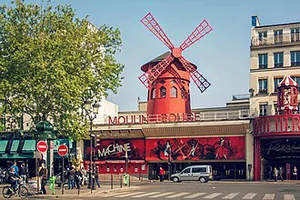
At the foot of Montmartre, where the neon glow of Pigalle fades into leafy Parisian streets, a red windmill has been turning since 1889. The Moulin Rouge isn’t just a cabaret. It’s a glittering, feathery heart of French nightlife, a place where dinner doesn’t simply happen and dancing isn’t a side act. Even from a block away, the crimson building pulls you in—neon light spilling onto the pavement, the promise of champagne and high kicks hanging in the air. You hear the orchestra before you see the stage, and those first few steps across the threshold feel a little like entering a time machine with a very generous wine list.
For more than 130 years, this venue has been where Paris goes to celebrate. It’s where the French cancan was raised to legend, where painters and writers mixed with aristocrats and dancers, and where the city’s love affair with spectacle was perfected. The place is glamorous, slightly naughty, and completely unforgettable. If you’re expecting a polished, touristy show without soul, you’ve come to the wrong address. The Moulin Rouge is a living piece of Belle Époque history, and it still knows how to make an entrance.
The story begins with two showmen, Joseph Oller and Charles Zidler, who opened the Moulin Rouge on October 6, 1889, just months after the Eiffel Tower first punctuated the Paris skyline. Their idea was as simple as it was radical: a theater where every social class could come together to drink, dance, and watch women kick their skirts high enough to raise a thousand eyebrows. The French cancan, with its wild high-steps and flashing petticoats, scandalized polite society. That only made Parisians love it more. The venue became a favorite subject for artists, especially Henri de Toulouse-Lautrec, whose posters and paintings turned the cabaret’s dancers into icons the world still recognizes today.
But history isn’t all glitter and saucer eyes. The original theater burned to the ground in 1915, and Paris feared the party had ended for good. It hadn’t. The Moulin Rouge was rebuilt, reinvented, and through the decades it kept adapting—surviving the rise of cinema, two world wars, and endless shifts in taste. By the 1950s it had become the legendary music hall you see today, complete with massive staged productions. In 1999, the current show, “Féerie,” was born: a two-hour explosion of sequins, feathers, and choreographed joy that still packs the house night after night. Around 80 artists, dozens of costume changes, and a wardrobe full of handcrafted headdresses ensure that every performance feels both effortless and wildly precise.
Once you’re inside, you’re not just watching a show. You’re seated inside a jewel box. The main hall is a lush mix of red velvet banquettes, gilded pillars, and shimmering chandeliers, with dark corners perfect for toasting whoever’s next to you. You’ve got two ways to experience it: buy an evening dinner-and-show ticket, or go for the show plus Champagne. Most people choose the dinner. Waiters will bring you salad, lamb, or lobster, while the stage erupts around you into a series of tableaux—pirate ships, cloudscapes, a blindingly beautiful finale of feathers that seems to stretch story-high. The French cancan is still the spark in the room, and the audience lets out a collective gasp every time the dancers kick into that signature line.
Plan for the full experience, because the evening runs long. A show-only visit lasts about two hours, but a dinner-and-show evening sits closer to three or four, and the tempo is deliberately unhurried. For most performances, you’ll want to arrive at least 30 minutes early so you can settle into your seat, order something cold, and share jokes with your companions before the lights drop. Ticket prices vary by season and package, but you’re generally looking at around €120 to €160 for a show-only ticket, while dinner-and-show packages tend to start nearer €230. It’s one of those rare splurges that feels justified by the sheer scale of what unfolds in front of you.
Photographers, take note: the best photo op isn’t even inside. Catch the glowing red windmill from the street at dusk, when the lights first begin to bounce off the wet pavement and the streets are still quiet. That’s the money shot. Inside, you’ll find plenty of visual candy too—vintage posters, Art Deco details, and the dramatic sight of the theater itself. But here’s the thing: during the performance, photography is strictly forbidden, and honestly, you won’t want to watch two hours of magic through a phone screen. Put it away. Use the interval to enjoy the foyer’s Belle Époque flourishes, and save your camera for the lobby and the facade.
One hidden gem most first-timers don’t notice is the live orchestra. In an age of backing tracks and sync tracks, the Moulin Rouge still performs with real musicians in the pit, which gives the whole evening a warmth you can feel in your chest. Another tiny secret: the balconies, though more distant, offer a sweeping view of the enormous stage-set machinery that keeps the show moving. If you’re lucky, you might see the wardrobe team fly through with fresh headdresses between numbers—a reminder that behind all that chaos and charm is a well-oiled machine. A few travelers dismiss the Moulin Rouge as pure kitsch, but they’re missing the point. It’s a living monument to Paris’s love affair with pleasure, laughter, and a little bit of scandal. You’ll leave with feathers in your memory, a smile on your face, and the distinct feeling that the French cancan will never quite be the same again.
