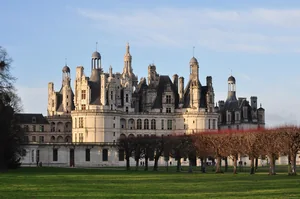
Let me paint you a picture: you’re standing at the edge of a giant forest, and ahead of you a castle rises from the mist, a confection of turrets, chimneys, and pointed spires. That’s Château de Chambord, the largest château in the Loire Valley, and one of France’s most breathtaking architectural achievements. It looks like a fairy tale, but it’s real. And the most incredible part? This enormous palace was built as a hunting lodge.
François I conjured this dream in the early 1500s, and he made sure no one would ever forget it. With over 440 rooms, 282 fireplaces, and 77 staircases, Chambord is a stunning showcase of Renaissance genius. But its real magic lies in the details — a mysterious double helix staircase, rooftops you can walk across like a city in the sky, and a symmetry that’s haunted and beautiful at once. It’s no wonder this place draws visitors from every corner of the globe.
The history of Chambord is as fascinating as the building itself. Construction began in 1519, and it was soon being called the ‘most expensive building project in Europe.’ François I wanted to show off his power, so he hired the best architects and engineers of his time. Legend has it that Leonardo da Vinci himself, who lived nearby as the king’s guest, helped design the famous staircase. While the documents don’t prove it directly, the staircase’s mechanical perfection feels like something from da Vinci’s notebooks.
Despite its splendour, Chambord saw little royal occupation. François I spent barely 72 days there in his entire life, mostly to show it off to visiting dignitaries. Later kings used it occasionally, but the château was never fully finished. During the French Revolution, its furniture was sold, and the building stood empty for decades. It even served as a military hospital during World War I. But instead of fading into ruin, Chambord slowly regained its glory, thanks to meticulous restoration projects. Today, it’s a UNESCO World Heritage site and one of the most beloved landmarks in France.
When you visit, start your journey at the very heart of the castle: the double helix staircase. Climb it slowly, feeling the smooth stone beneath your hand. Notice how people on the opposite spiral can pass each other without ever meeting. This isn’t just a quirky architectural trick; it’s a symbol of the king’s cleverness. At the top, you’ll emerge onto the rooftop terraces, and honestly, this is where Chambord truly lets you in on its secrets. Walk through a labyrinth of chimneys, cupolas, and sculpted walls that look like a medieval city from a dream. This was the king’s playground, and the view over the forest and the manicured gardens below is absolutely unforgettable.
Inside the rooms, you’ll find exhibitions on the two great themes of the castle: hunting and architecture. The grand apartments, though not as lavishly furnished as Versailles, are filled with period details, tapestries, and elegant décor. My advice? Take your time. Wander into the lower hall with its magnificent vaulted ceiling. Don’t miss the four rooms devoted to hunting trophies — they’re a hidden gem that many visitors rush past. The carved antlers and boar heads might feel odd, but they tell the story of a royal obsession. And if you’re keen on secrets, look for the small, barely marked corridor beneath the staircase. It leads to a tiny space where you can look up at the spiraling structure from below. It’s pure magic.
Plan for at least two to three hours here, maybe longer if you love architecture or photography. A ticket costs around €14.50, and it’s well worth it. Arrive early in the morning to catch the soft light on the white stone, or stay into the late afternoon when the crowds thin and the château takes on a quieter, more mysterious atmosphere. As for photo spots, the rooftop is unbeatable, but the reflection shot from across the moat is just as famous — on a still day, the entire castle glimmers in the water. Another gem? The view of the double staircase from the third-floor walkway. Wait for a moment when there’s no one else in the frame, and you’ll have a photo that looks like it belongs in a museum.
Château de Chambord isn’t just a stop on a tour; it’s a journey into the mad, beautiful imagination of a king who wanted to build something impossible. Centuries later, it still stands, plain and proud in the middle of nowhere, a concrete echo of Renaissance ambition. You might arrive as a tourist, but you’ll leave as a believer — in art, in history, and in the sheer pleasure of getting utterly, gloriously lost inside a castle that refuses to be anything but magnificent.
