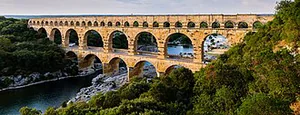
Sunlight filters through a screen of plane trees as you round the bend, and then you see it—a colossal honey-colored giant straddling the Gardon River. The Pont du Gard doesn’t just impress; it humbles. Three tiers of arches climb 49 meters into the sky, stretching 275 meters across the valley with a rhythm so perfect you’d think it was carved by a single chisel. Built almost two thousand years ago, this is no ruined relic. It’s a standing, walkable, touchable Roman masterpiece, and it’s been busy doing what it does best: carrying water, then people, then myths, ever since.
Why is this unassuming bridge in southern France so legendary? For starters, it was the vital link in a 50-kilometer aqueduct that supplied the ancient city of Nimes. The engineering genius is staggering: over the entire distance, the water drops just 17 meters—a gradient so gentle it’d be nearly impossible to detect by eye. Yet the Pont du Gard isn’t just an aqueduct. It’s a lesson in resilience, a bridge that survived the fall of empires, medieval mischief, and floods that should have crumbled it. It’s also a UNESCO World Heritage Site and a place where you can still hear the faint whisper of Roman footfalls.
The story begins in the 1st century AD, likely during the reign of Emperor Claudius or Nero, when the Romans set out to bring fresh spring water to the growing city of Nemausus, today’s Nimes. The aqueduct needed to cross the Gardon gorge, and so engineers and thousands of workers raised this limestone colossus without a single drop of mortar in its main archways—just precisely cut stones interlocking in a genius system of dovetail-like connections. For centuries it did its silent job, ferrying an estimated 40,000 cubic meters of water daily. But when Rome fell, the aqueduct’s purpose faded. Debris clogged the canal, and the bridge was abandoned to time.
Fate, though, had other plans. In the Middle Ages, the Pont du Gard reinvented itself as a toll bridge, letting travelers and their pack animals cross the river on its lower level. This second life saved it from being quarried for stone, which explains why so much of it remains astonishingly intact. In the 18th century, a young Napoleon III ordered thorough restorations, and in 1855, the third tier was strengthened for tourists. By 1985, UNESCO recognized its global importance. Yet nothing could have prepared it for the modern era: today, you don’t just gaze at the Pont du Gard—you can climb it, walk across its ancient spine, and splash in the river beneath it.
Let’s get practical. You’ll almost certainly start at the museum and visitor center on the left bank. It’s worth your time, but keep in mind the building is just the overture. The real show begins the moment you step outside. Walk the short grassy path toward the bridge, and you’ll feel your pace slow naturally. You can cross the river on the second level—the route the ancient Romans probably used—and run your hand along the colossal limestone blocks that were placed before your great-great-grandparents’ grandparents were even dreams. For a closer look at the aqueduct channel itself, follow the staircases that wind up to the watercourse on the top tier. Some sections are roped off, but you’ll still feel the ghost of flowing water.
How much time should you block out? At the bare minimum, give yourself two hours to walk across, explore both banks, and snap a thousand photos. But honestly, half a day feels right. Pack some snacks and simply sit by the water. On hot summer days, you’ll see locals and travelers wading and even swimming in the clear, blue-green shallows right under the looming arches—an experience that’s equal parts refreshing and surreal. There are also interpretive trails, a Mediterranean garden (the “Mémoires de Garrigue”), and an old mill (the Moulin des Pères) waiting to be discovered. You’ll find that most crowds hug the parking side; venture ten minutes to the opposite bank and you’ll often have the riverbank all to yourself.
As for tickets, here’s the pleasant surprise: viewing the Pont du Gard is completely free. You can wander right up to it, walk across it, and admire it from any angle without paying a cent. What you will pay for is parking in the official lots, plus the museum and cinema sessions if you want the full historical context. A combined ticket for the museum and cultural spaces runs around €9.50 for an adult, less for kids and students, and there are family rates. Honestly, the museum’s collection of Roman engineering models and 3D animations is worth every euro. But if you’re on a tight budget, skip it—the bridge itself is the most magnificent exhibition you’ll find anywhere in France.
Now, for the photographers out there, let’s talk angles. The classic postcard shot is from the riverbank downstream, where you get the full curve of the upper arches mirrored in the water. Early morning light is a dream—the stone glows gold, and you’ll have the place almost to yourself. Sunset works magic, too, especially from the left bank, where the sun’s final kiss frames the bridge against the warm limestone. Another underrated spot: climb the rocky path on the right bank. From up there, you’ll see the aqueduct winding into the distance like a sleeping serpent, a perspective most visitors never catch.
And here’s a hidden gem many people miss: the lower level of the bridge, which functioned as a carriage road in medieval times, is still open to walkers. It’s a wide, stony corridor that feels like stepping into a time machine, and its acoustics are wonderfully eerie—hum a tune and the arches answer back. You’ll also notice mysterious rectangular sockets and projecting stones; these aren’t random damage, but the remnants of ancient scaffolding holes and medieval additions. Take a moment to rub the worn paving underfoot and wonder how many sandals, hooves, and boots have crossed before yours.
In the end, the Pont du Gard is more than a bridge or an aqueduct. It’s a place where the immensity of history becomes oddly intimate. Standing on that bank, watching a heron skim the river while the sun carves shadows across the arches, you might feel a strange connection to the people who laughed, sweated, and toiled here two millennia ago. You’ll wonder how a society could build something so perfect without modern computers—and how we, with all our technology, still can’t help but feel awe at their creation. That’s the magic of this place. It doesn’t demand your admiration. It just quietly earns it, arch by arch, stone by stone, century after century.
So whether you’re chasing Roman history, a perfect photograph, or simply a beautiful day out in the French countryside, come to the Pont du Gard. Stand beneath its silent sentinels. Let its age wash over you. You’ll leave with more than just souvenirs—you’ll leave with the rare, precious certainty that some things really are built to last forever.
