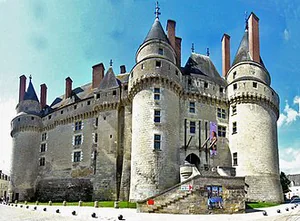
Standing watch on the banks of the Loire River, Château de Langeais is a fortress with a soft side. Its gray stone towers and formidable machicolations scream medieval military might, yet inside, it’s a palace built for celebration. This isn’t your typical fairy-tale castle. It’s a blend of stern fortification and delicate Renaissance luxury, and it holds a secret: the very spot where the fate of France was sealed with a royal wedding.
From the moment you approach, the castle captures your imagination. Built low and sturdy against the river, it looks like it could repel any army with a single glance. But you’ll also notice elegant windows and fine stonework that hint at a more refined life behind those walls. That contrast—between warrior and aristocrat, between rough stone and gilded interiors—makes Langeais utterly unforgettable.
Langeais wasn’t born as one grand building. Its story begins in the late 10th century, when Fulk III, Count of Anjou—a man known as ‘Fulk the Black’—ordered a massive stone keep to dominate the surrounding region. That keep, one of the oldest in France, still stands as a proud ruin on the grounds. Its massive walls and primitive archways are a stark reminder of a time when survival mattered more than style.
Centuries later, the castle entered a new chapter. In 1465, Louis XI commissioned his treasurer, Jean Bourré, to build a modern castle right next to that old medieval keep. Bourré used the existing fortress as a foundation and created a masterpiece of 15th-century architecture. The result was an elegant dwelling that still looked like a fortress, but with real glass windows, grand fireplaces, and all the comforts a Renaissance noble could want.
Then came the moment that made Langeais eternally famous. On December 6, 1491, in the castle’s grand great hall, the 21-year-old Anne of Brittany married Charles VIII of France. That simple ceremony ended centuries of conflict between Brittany and France. The marriage effectively tied Brittany to the French crown, and historians agree this was a giant step toward the country we know today. Standing in that very room, you feel the weight of that moment. The space hasn’t lost its ceremonial aura, and it’s easy to imagine the candlelight flickering over armored dignitaries and silk gowns.
Over the following centuries, Langeais fell from royal favor but never lost its charm. It survived the French Revolution relatively intact, partly because it was sold off as national property. In the 19th century, an eccentric ironmaster named Jacques Siegfried bought the castle and set about restoring it with loving care. He brought in extraordinary collections of furnishings, tapestries, and art, and eventually donated the entire estate to the Institut de France, which maintains it to this day.
Today, your visit starts with a sight that never gets old: the massive exterior walls rise straight out of the dry moat, and the drawbridge welcomes you like a scene from a historical epic. Once inside, you’re transported. Wandering through the sumptuously furnished rooms feels like stepping into a 15th-century royal residence that just woke up from a nap. Don’t miss the sprawling great hall where the famous marriage took place—the vast fireplace and ornate ceiling will leave you staring upward in awe.
The castle also boasts an impressive collection of tapestries, including a rare set depicting the legend of the Knight of the Swan. But for many visitors, the true highlight is climbing the spiral staircase to the rooftop terrace. From up there, you’ll get sweeping views over the Loire Valley, with its patchwork fields and slate-roofed villages. It’s the perfect place to snap that postcard-worthy photo.
But don’t rush. Plan to spend at least two hours here, maybe more if you’re a history buff. The ticket price is around 11 euros, and it’s worth every cent. For something a little less obvious, wander past the old keep at the back of the property. It’s a crumbling gem from the year 1000, and walking through its silent stone chambers feels strangely intimate compared to the polished castle next door.
For photographers, the best shots come from the garden terrace you’ll find after crossing the moat. That angle lets you capture the full silhouette of the castle with the Loire shimmering in the distance. Early morning or late afternoon light makes the stone glow warmly, which is a bonus for your Instagram feed. And if you look closely at the castle’s exterior, you’ll spot tiny sculpted details—grotesques, vines, and heraldic animals—that most people walk right past.
One of Langeais’ most endearing secrets is its ‘camera obscura’, a clever device in one of the upper rooms that casts real-time images of the surrounding town onto the wall. It’s not ancient, but it’s a fun throwback to a time before photography. Ask a staff member to switch it on; they’re usually happy to oblige.
A visit to Château de Langeais is more than a wander through old rooms. It’s a chance to touch France’s political DNA. You’ll stand where a young duchess changed a nation’s map, stroll through halls that hosted kings, and feel the centuries peeling back around you. Just leave yourself enough time to soak it all in. This is one castle that rewards the slow traveler, the curious soul, and anyone who loves a good royal story.
