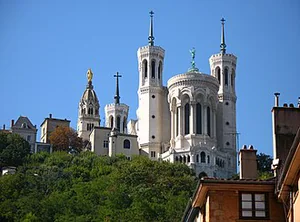
Lyon is a city built on two rival hills. Down by the rivers, life whirls in the lively squares of the old town, but the city’s soul is tethered to the skyline. The Basilica of Notre-Dame de Fourvière crowns the western hill, a massive, ornate masterpiece that locals lovingly call the “inverted elephant.” From a distance, it looks like a colossal, bejeweled beast, its legs planted firmly in the earth while its back reaches for the heavens.
First impressions here are deceptively simple. Up close, the Basilica abandons any sense of standard scale. It’s not just a church; it’s a fortress of pure faith, dripping with turrets, gilded towers, and intricate carvings. As you stand on the vast esplanade, the sprawling city of Lyon sprawls beneath you. Locals often say you haven’t really seen Lyon until you’ve seen it from Fourvière. I’m inclined to agree. The sparkling white stone seems to capture the changing light, shifting from cool ivory at dawn to a blazing, honey-colored monolith at sunset.
History runs deep in these stones. In the middle of the 19th century, France was sliding into the chaos of the Franco-Prussian War. Prussian forces were marching relentlessly through provinces, leaving devastation in their wake. The desperate residents of Lyon made a passionate vow to the Virgin Mary, begging for protection. They promised to build an extraordinary church if their city was spared. The region remained safe, and the people made good on their word. Construction began in 1872 on the ancient site of the Roman forum of Trajan, a place that had once housed pagan temples and civic grandeur.
The architect at the helm was Pierre Bossan. His vision was wildly ambitious, pulling together Byzantine, Romanesque, and Gothic influences into a single, cohesive dream. Workers laid the first stones in 1872 and finished the main exterior remarkably quickly, by 1884. The Basilica was consecrated in 1896, cementing its status as a spiritual guardian. Yet, the most intriguing part? The two massive towers aren’t dedicated to saints or bishops of Lyon. They’re named after St. Michael and St. Thomas, acting as subtle reminders of the spiritual armor the people sought during those dark war days.
Step through the heavy wooden doors, and you’ll enter a completely different world. Inside, the Basilica is an explosion of color and light. The nave is a vast hall, wider than you’d expect, and every single corner is adorned with brilliantly polished mosaics. Scenes from the Bible, saints, archangels, and swirling floral patterns burst from the walls and ceilings. Gold leaf shimmers in the dim candlelight, casting a warm, otherworldly glow. It takes your breath away. It’s easy to spend a solid twenty minutes just staring upward with your mouth slightly open, stunned by the sheer amount of artistry crafted by human hands.
When you’re ready to move, don’t rush. First, take a deep breath and climb the short staircase to the rooftop terrace. You’ll pay a small fee (around 6 euros) to access it, but trust me on this bit. The spiral stairs are a bit of a workout, yet the payoff is immense. The panoramic view stretches across the whole city. You’ll see the Saône river winding gracefully below, the red-tiled rooftops of the old town, and on a clear day, the majestic peak of Mont Blanc far off on the horizon. It’s a photographer’s paradise, so charge your batteries and bring your wide-angle lens.
Hidden gems are scattered around the Basilica if you have the patience to look. Most visitors zip past the main level and head straight outside. Instead, descend into the crypt. It’s dedicated to St. Joseph and stands in stark contrast to the jewel-box nave above. The walls are plainer, the stone rougher, and the air feels quieter. It’s here that you get a sense of the building’s true power—a place for genuine introspection, away from the tourist buzz. Also keep an eye out for the small museum of sacred art tucked away on the premises. It holds a range of religious artifacts, vestments, and historical treasures that many guests completely overlook.
How long should you spend inside? Give yourself at least an hour and a half. Entry to the Basilica itself is completely free, which makes it an even more incredible attraction. The rooftop, crypt, and museum are all part of the experience. For the ultimate photo spot, head back out to the esplanade just before dusk. Position yourself near the golden statue of the Virgin Mary, turn your back to the sunset, and let the warm light dramatically illuminate the Basilica’s intricate facade and the entire valley behind you. You’ll walk away with a lasting memory, a few photos, and a deep appreciation for this extraordinary sanctuary perched high above Lyon.
At the end of the day, Notre-Dame de Fourvière isn’t just a monument to visit; it’s a living part of the city. People still come to pray, to celebrate, and to find peace. Sit quietly in one of the pews for a moment and watch the flickering candles. The contrast between the chaos of the modern world and the timeless silence of this stone sanctuary is something you won’t quickly forget. Whether you’re a spiritual traveler or simply an admirer of stunning architecture, this basilica will leave its mark on you.
