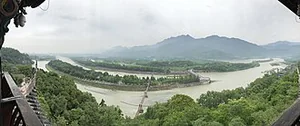
Here’s a fact that might surprise you: the world’s greatest ancient engineering marvel isn’t a soaring tomb or a golden temple. It’s an irrigation system. And it still shows up for work every single day. Dujiangyan, a sprawling water-management complex on the Min River in Sichuan Province, has been taming floods and nourishing the Chengdu Plain for more than 2,200 years. No dam. No pumps. No computer models. Just a brilliant arrangement of stones, bamboo, and human intelligence.
Many visitors arrive expecting a dramatic wall of water or a massive modern structure. Instead, you get something better — a place where the river does exactly what it’s told, without ever realizing it’s been told. Stand at the Fish Mouth, a levee shaped like the bow of a ship, and watch the greenish current split in two. One branch slips calmly into an irrigation channel; the other rushes onward. That quiet, effortless control is what makes Dujiangyan so extraordinary.
Back in 256 BC, China was in the chaotic Warring States period. The Min River was a menace, swelling into devastating floods every monsoon season and destroying farmland throughout the Shu region. The Qin state sent a local governor named Li Bing to fix the problem. But Li Bing wasn’t interested in waging war on the river. Instead, he spent years studying its currents, the seasonal rhythms, and the local geology. His plan was not to block the river, but to work with it.
Li Bing’s design has three main parts, and you’ll see them all on your visit. The Fish Mouth divides the water into an inner channel—for irrigation—and an outer channel for flood discharge. Next comes the Flying Sand Weir, a low spillway reinforced with bamboo cages and stones, engineered to allow excess water to overflow safely during floods. Finally, he carved a narrow passage through a rock outcropping, the Bottle Neck, which acts as a final control gate. Together, these held the river in balance, ending the floods and turning the Chengdu Plain into one of China’s most fertile regions, sometimes called the ‘Land of Abundance.’
What’s truly mind-blowing is how little the system has changed. Li Bing’s motto, carved on a stone plaque near the river, was: ‘Dig the channel deep, keep the weir low.’ That modest, adaptive philosophy is why Dujiangyan has survived every earthquake, typhoon, and dynasty for over two millennia. It even survived the 2008 Wenchuan earthquake, which struck just 50 miles away. The site was damaged, but the core structure held. UNESCO recognized it as a World Heritage Site in 2000, and today this ancient system still irrigates roughly 2.2 million acres of farmland. That’s not a historical relic; that’s a working piece of the present.
To truly grasp Dujiangyan, you have to walk it. Start at the viewpoint above the Fish Mouth, where you’ll see the full layout — the river splitting around a long, slender island that looks like the deck of a sunken ship. Then come down onto the levee itself. You’ll stand with the water rushing on both sides, and it’s both thrilling and humbling. Follow the trail along the inner channel to the Flying Sand Weir. On a calm day, it’s a lazy stretch of shallows; after heavy rain, it turns into a roaring cascade. Either way, you’re looking at a 2,000-year-old flood-control system that’s still doing its job, right in front of you.
The Anlan Suspension Bridge, also called the Marriage Bridge, is the heart of the visitor experience. It’s a 300-meter-long rope bridge that sways with every step, and you’ll probably find yourself laughing and gripping the railings like a kid. The bridge was built long ago to let families on opposite banks visit each other — hence the romantic nickname. Cross to the other side, and you’ll climb up to Erwang Temple, the red-walled shrine to Li Bing and his son. The climb is worth it, because the panoramic view from the top is one of the best photo spots in Sichuan. Fancy another vantage? Head across the river to Fulong Temple, where a weathered stone statue of Li Bing stands watch. That statue was pulled straight from the riverbed in the 1970s, which feels deeply poetic.
You’ll want three to four hours inside. The main loop — Fish Mouth, weir, Bottle Neck, both temples, plus the bridge — is around six kilometers of friendly walking. Entry tickets run about 80–90 yuan, and given the scale and upkeep, that feels more than fair. Go early, though. By ten in the morning, tour groups flood in, and the quiet magic disappears under a sea of umbrellas and selfies. If you can time your trip for late March or early April, you’ll catch the Water Releasing Festival. It’s a deep-rooted tradition that honors Li Bing’s legacy with colorful parades, drums, and ancient-style ceremonies. Bigger crowds, but unforgettable.
Now for the hidden gems. Most visitors cross the bridge, snap a few shots, and head to the temple. But take the quieter footpath along the left bank of the inner river, and you’ll find a small stone plaque inscribed with Li Bing’s famous advice about engineering. Reading it as you stand next to the very water it helped control is a goosebump moment. Another secret: the back terrace of Erwang Temple’s garden is usually deserted. Grab a cup of jasmine tea from the little stand, sit under the ancient camphor trees, and listen to the river humming far below. That’s the real Dujiangyan — not just an artifact to photograph, but a living, breathing landscape that locals still come to savor.
