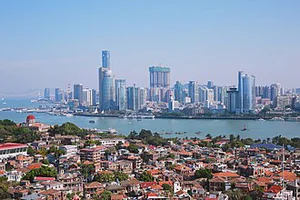
Step off the ferry, and the world tilts. No cars. No honking. No traffic lights. Instead, the only sounds that greet you are the rustle of banyan leaves, the clink of tea glasses from a courtyard, and the echo of a piano scale being practiced somewhere above the cobblestones. This is Gulangyu, a one-and-a-half-square-kilometer island that punches far above its size.
It’s often called “Piano Island” or “Sea Garden,” and both nicknames fit. Around the turn of the twentieth century, this place had more pianos per capita than anywhere else in China, and you’ll find that musical soul woven into the streets, the gardens, even the museum devoted to piano history. But the island offers so many other ecstasies: a jumble of colonial architecture, hidden microneighborhoods, quiet sandy coves, and a relaxed pace that makes mainland cities feel like they’re being fast-forwarded. Gulangyu has a way of unhurrying you. Within minutes, you’ll find yourself pausing to watch a cat stretch on a sun-warmed step or to read the calligraphy above a doorway.
In 2017, UNESCO recognized Gulangyu as a World Heritage Site, celebrating it as a “melting pot of cultural influences.” For the visitor, that’s just a fancy way of saying: everywhere you look, there’s a chapter of history waiting to be told.
Gulangyu’s story begins with salt, opium, and tea. After the Opium War, the Treaty of Nanking in 1842 opened Xiamen to foreign trade, and Britain was quick to claim a foothold. By the 1850s, consulates from a dozen countries had sprouted along the island’s edges, each flying a different flag. These grand European buildings—neoclassical columns, Victorian gables, even miniature castles—appeared next to traditional Chinese courtyard homes. The result is a curious, beautiful architectural mix you won’t see anywhere else.
Then came the pianos. Missionaries and foreign merchants brought instruments with them, and local families quickly fell in love. By the 1920s, Gulangyu was producing its own piano technicians and composers. Wealthy overseas Chinese, returning from Southeast Asia, built lavish villas here—complete with marble staircases, stained glass, and spacious music rooms. You can still wander through these mansions today, their walls holding the memory of a time when an evening of chamber music was the highest social occasion.
But the island’s history isn’t all moonlit sonatas. Japanese forces occupied Gulangyu during WWII, and the island fell quiet for years. After the war, the foreign consulates gradually left, but the architectural treasury remained. In the 1990s, the Chinese government shut down motor vehicles to preserve the island’s character, and the 2017 UNESCO designation locked in its status as a global treasure. Today, roughly 20,000 residents live in those same streets, their laundry drying from wrought-iron balconies while tourists wander past on their way to the next piano-themed café. The most famous building of this era is the Bagua Floor, an octagonal, eight-sided marvel that once housed the Japanese consulate and later a school. It now stands as a surreal emblem of the island’s tangled past.
Start your exploration at Sunlight Rock, the island’s highest point. It’s a short but steep climb through tropical foliage, and the reward is a panoramic sweep of Xiamen’s skyline, the sea, and the island’s red rooftops below. From there, meander downhill to Shuzhuang Garden. Built in 1913 for a wealthy Taiwanese emigrant, this beautiful hillside garden hides a surprise: an ocean-side maze of rockeries and pavilions that seem to fold into each other. You’ll get thoroughly lost in the best way.
For piano lovers, the Piano Museum is non-negotiable. Housed in a seaside villa, it contains more than a hundred antique instruments, including one quirky piano with a built-in drum and cymbal. But Gulangyu rewards slow, aimless walking more than any check-list. Wander the unnamed lanes behind the main drag. There you’ll find tiny bakeries, elderly neighbors playing mahjong under a giant banyan tree, and cat statues peeking from rooftops. Stop for a bowl of fish-ball soup at a hole-in-the-wall eatery, or grab a bag of fresh-baked coconut pastries—they’re the island’s favorite treat. Give yourself at least five hours—honestly, you could spend a whole day here and still miss half the island’s secrets.
There’s no separate fee just to step onto the island; instead, you buy a combined attraction ticket that covers the main sights like Sunlight Rock, Shuzhuang Garden, the Piano Museum, and a few others. It’s efficient and worth the cost if you plan to see everything. The real magic, though, happens during the golden hour. Head to the northwestern beach around sunset, where the sky goes peach and lilac, and the World Heritage architecture glows like a stage set. That’s your postcard photo.
Now, the hidden gems. Most visitors hug the coastline, so plunge into the island’s heart. Look for a small, unmarked museum dedicated to traditional Chinese wind instruments—if you find it, you’ll likely have the place to yourself. And keep an ear out for impromptu concerts: a violinist practicing in a courtyard gate, a child stumbling through a Mozart minuet in a second-story loft. On a quieter day, you might spot the island’s famous resident tortoises sunbathing in the pond of a forgotten villa. These little moments are what make Gulangyu feel less like a tourist stop and more like a living, breathing town.
