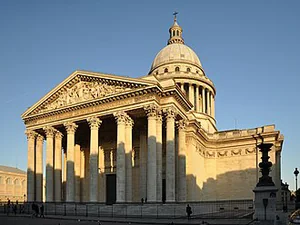
Towering over the Latin Quarter like a stoic guardian, the Panthéon is one of Paris’s most awe-inspiring yet often overlooked monuments. With its colossal columns and magnificent dome, it draws the eye from blocks away, promising something extraordinary within. But this isn’t just another pretty church—it’s France’s secular mausoleum, the final resting place of the nation’s greatest minds and heroes. Voltaire, Rousseau, Victor Hugo, Marie Curie—their mortal remains lie here, honored beneath soaring stone arches and breathtaking frescoes.
Step inside, and the sheer scale hits you like a wave. The vast nave rises above you, flooded with natural light that streams through cleverly designed openings. The air feels still, almost sacred, charged with the weight of centuries of French history. You don’t need to be a history buff to feel it. Whether you’re standing beneath the magnificent dome or gazing at the massive pendulum that proves the Earth rotates, the Panthéon grabs hold of your imagination and doesn’t let go.
Originally commissioned in 1744 by King Louis XV, the building began life as a church dedicated to Saint Genevieve, the patron saint of Paris. The king made a vow: if he recovered from a serious illness, he’d build a grand monument in her honor. He recovered, and architect Jacques-Germain Soufflot was tasked with creating something truly extraordinary. Soufflot drew inspiration from classical antiquity—think Greek and Roman temples—and the result was a revolutionary fusion of lightness, grandeur, and neoclassical design. Construction took decades, and by the time the building was completed in 1790, the French Revolution had transformed the nation entirely.
The revolutionaries, never ones for half-measures, decided the gleaming new structure was too good for a saint. They turned it into a secular temple dedicated to France’s great men. The words above the entrance—”Aux grands hommes, la patrie reconnaissante” (To great men, from a grateful nation)—still greet visitors today. Over the centuries, the Panthéon has flip-flopped between church and secular mausoleum, depending on who held power. King Louis XVIII turned it back into a church; Napoleon restored it as a secular building; and in 1885, when Victor Hugo died, it became permanently the grand secular temple you see today. That said, don’t expect a somber experience. It’s a place of celebration, a tribute to human achievement.
So, what should you actually see once you’re inside? The ground floor alone could keep you busy for an hour. Look up, way up, at the dome—it’s one of the finest in Paris, an engineering marvel of triple shells and stone rings. But your eyes will inevitably be drawn to the vast frescoes lining the walls, painted by some of France’s finest 19th-century artists, depicting the Christian history of Paris alongside scenes of revolutionary fervor. The centerpiece, though, is Foucault’s Pendulum—the original is in the Musée des Arts et Métiers, but this full-size replica swings majestically from the dome and demonstrates Earth’s rotation in real time. It’s subtly mesmerizing, and you might find yourself watching it for longer than expected. Also, don’t miss the crypt below. It’s a labyrinth of corridors lined with the tombs of over 80 iconic figures, and it feels remarkably quiet, almost like a hushed underground city. You’ll wander through dim stone hallways and spot marble plaques honoring scientists, writers, and politicians. Give yourself at least two to three hours to do the whole experience justice—longer if you plan to climb the 206 steps to the colonnade for one of the most spectacular views of central Paris. The climb is a workout, but the payoff is a sweeping 360-degree panorama over the rooftops, with the Eiffel Tower, Notre-Dame, and the Tower Montparnasse all laid out before you.
As for practicalities, tickets are required for the paid entry—which includes the crypt, the main nave, and the dome colonnade access. Check the official Panthéon website for current rates and timings, as they change depending on the season and special exhibitions. But here’s a tip: on the first Sunday of every month (from October through March), entry is free, and on the main national holidays like Bastille Day and the European Heritage Days in September, it’s free too. If you’re in the queue and feeling thrifty, those dates can make a big difference. Just be prepared—free days mean crowds, so arrive early or be ready to wait. There’s no escaping the serpentine line under the hot Parisian sun, but once you’re inside, the hustle fades away.
For the best photographs, head to the front entrance first thing in the morning. The golden light hits the Corinthian columns and makes the stone glow. The large plaza in front of the Panthéon is wide enough to capture the full grandeur of the facade without other buildings getting in the way. Up on the colonnade, the views dwarf everything in your frame—it’s the ultimate hero shot. But don’t forget the little details: the sculptural reliefs on the pediment, the intricate mosaics on the floor, and the subtle play of light on the dome’s interior as the sun moves across the sky.
Then there are the hidden gems most tourists rush past. Look for the statue of Diderot, the Enlightenment philosopher, placed near the crypt entrance—it’s easy to miss if you’re not paying attention. Also, seek out the poignant tomb of Marie Curie, buried here with her husband Pierre, and the first woman to be interred in the Panthéon on her own merits. Her tomb is thick with lead due to her work with radium, and it’s a sobering reminder of the sacrifices behind the discoveries. And if you’re feeling adventurous, take a moment to stand very still in the middle of the nave. The acoustics are extraordinary—a whisper carries, and the silence that follows feels full of presence.
Before you leave, step back outside and take a long look at the inscription on the pediment. “Aux grands hommes, la patrie reconnaissante.” You’ll likely have walked past this building for years, never thinking twice. But once you’ve wandered its hallowed halls, you understand what this place truly represents: a nation saying thank you to the minds that shaped it. It’s not just sightseeing. It’s an encounter with the soul of France. So go ahead—linger a little longer. The Panthéon doesn’t mind. In fact, it feels built for exactly that.
