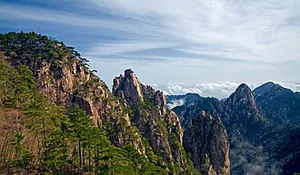
There are places you visit, and then there are places that visit you back. Huangshan—the Yellow Mountain—belongs firmly to the second category. Rising like a half-remembered dream from the subtropics of Anhui Province, this UNESCO World Heritage site is the very definition of awe. It’s a landscape that feels less like solid earth and more like a master painter’s fantasy: granite peaks that pierce the clouds, pine trees clinging to bare rock at impossible angles, and seas of mist that roll through valleys with a mind of their own. Stand there long enough, and you’ll swear the mountain is alive.
What makes Huangshan different from other famous peaks? It’s not just the height—the tallest summit, Lotus Peak, reaches a respectable 1,864 meters. It’s the geometry and the atmosphere. The mountains were sculpted by glaciers and time into jagged pillars and twisted stone forests, often wrapped in fog that turns the world into a silent, monochrome panorama. Every step feels like walking through an ink-wash painting that’s still wet. For centuries, this place has been China’s ultimate natural icon, a source of artistic inspiration and spiritual pilgrimage. And let me tell you—it lives up to every bit of the hype.
The story of Huangshan stretches back far beyond human memory, but its cultural history began in the Han Dynasty, around 2,000 years ago. At that time, the mountain was known as Yishan, or ‘Mountain of the Black Mulberry.’ It wasn’t until 747 AD, during the Tang Dynasty, that the name changed to Huangshan, supposedly after the legendary Yellow Emperor Huangdi, who was said to have ascended to immortality here. That myth set the tone. Daoist hermits soon moved into the cliffs and caves, seeking enlightenment among the mist and stone. They believed the mountain was a gateway to the divine—and honestly, when you watch the dawn break over a sea of clouds, you’ll understand why.
During the Ming and Qing dynasties, Huangshan truly found its voice. The famous ‘Huangshan School’ of painting emerged here, led by artists like Shi Tao and Hongren, who spent years sketching the mountains from life. Their works didn’t just depict nature; they taught people how to see it. The poet Li Bai also came, in the 8th century, and left behind verses that still echo in Chinese literature. By the 20th century, Huangshan had become a symbol of the nation itself—so much so that a pair of its legendary pines was even featured on Chinese banknotes. In 1990, it was declared a UNESCO World Heritage Site for both its natural beauty and its profound impact on art and culture. Today, it welcomes millions of visitors each year, yet the mountain remains wild at heart.
So, what should you actually do once you’re up there? First, give yourself time. Huangshan isn’t a drive-by attraction; it’s a 2 to 3-day experience. Most sane visitors take a cable car up—there are two main ones, from Yungu Temple and Ciguang Pavilion—but once you’re on top, you’ll want to spend at least one night in a hotel on the mountain. Yes, it’s a bit pricey and the beds can be basic, but waking up to the sunrise tour is worth every penny. The classic loop takes you to the West Sea Grand Canyon, a dizzying series of stone staircases descending into a misty abyss. You’ll also want to visit Bright Summit Peak, the perfect place for a panoramic view, and the famous Guest-Greeting Pine, a crooked old tree that’s been posing for photographs for centuries.
Timing matters more than you’d think. The mountain is gorgeous year-round, but each season has its own character. Spring brings fresh green and wild azaleas; summer offers clearer skies but more crowds; autumn ignites the foliage in amber and crimson; and winter coats the pines with frost, turning the peaks into a crystalline fairytale. If you can, visit in late autumn or early winter for the best chance of a ‘sea of clouds’—that low-lying fog that fills the valleys and makes the peaks look like islands in an ocean of white. Sunrise and sunset are the golden hours, so position yourself at the Dawn Pavilion or the Flying-Over Rock about an hour early. Bring a jacket, even in summer; at 1,800 meters, the wind bites.
Now, the practical stuff. Tickets cost around 190 RMB during peak season and 150 RMB in winter, with cable cars priced separately at about 80 RMB per ride. Honestly, a 2-day trip will eat up somewhere in the neighborhood of 600-800 RMB per person just on access and transport, not including lodging. But here’s a trick: enter through the less crowded Songgu Temple entrance in the north instead of the usual hotspots. You’ll save time and see a quieter, equally stunning side of the mountain. And if you’re fit, consider skipping the cable car on the way down and walking the old stone steps from the Ciguang Pavilion. It’s a thigh-burner, but along the way you’ll discover hidden crevices, tiny shrines, and waterfalls that most cable-car visitors never see.
Finally, don’t forget the hidden gems. Most crowds flock to the main peaks, but the lesser-known ones like Shixin Peak and Shixin Pavilion offer jaw-dropping views with a fraction of the tourists. Keep an eye out for the ‘Buddha’s Light’—a rare optical phenomenon where your shadow, surrounded by a rainbow halo, appears on the clouds below. It only happens a few times a year, usually on sunny, misty mornings. And if you have an extra day, take a short trip to the nearby Hongcun village, a beautiful ancient settlement that shares the same visual DNA as Huangshan. But the mountain itself? It needs no supporting act. Stand at the edge of a cliff, watch the clouds swallow a ridge, and you’ll understand why the Yellow Emperor never came back down.
