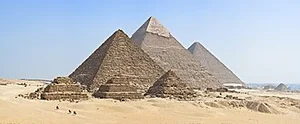
You’re standing in the desert, and the air feels heavier than you expected. The sun beats down, and there they are—three colossal shapes cutting into the horizon, so impossibly old and so impossibly perfect that your brain struggles to catch up. The Pyramids of Giza aren’t just a relic from history; they’re a dare thrown across five thousand years. You can’t help but wonder: how did they do it, and why does being here make your chest feel tight?
These aren’t just big piles of stone. The Great Pyramid of Khufu alone stood as the tallest man-made structure on Earth for nearly four millennia. Its base covers thirteen acres, and its original limestone casing once made it gleam like a mirror under the African sun. Alongside Khufu’s monument are the pyramids of his son Khafre and grandson Menkaure, plus the enigmatic Sphinx, temples, causeways, and a sprawling necropolis that holds tombs for nobles and queens. It’s a city of the dead, but it feels utterly alive.
What makes Giza truly magical is its location. The pyramids sit on a rocky plateau at the edge of the Western Desert, just a stone’s throw from the bustling sprawl of modern Cairo. That collision of ancient stillness and contemporary chaos is part of the charm. You can hear the honking of cars from nearby roads, yet the monuments themselves stand silent, aloof, and utterly indifferent to the world that has grown up around them.
The story of these pyramids begins around 2550 BCE, during the Fourth Dynasty of the Old Kingdom. Pharaoh Khufu, the second ruler of that dynasty, commissioned the Great Pyramid as his tomb—a stairway to heaven that would guarantee his eternal place among the gods. Tens of thousands of skilled workers, not slaves, as popular legend insists, spent roughly twenty years hauling limestone from nearby quarries and granite from far-off Aswan. They built ramps, used levers, and organized a labor force so efficient that even modern engineers stand in awe.
Khufu’s son Khafre built his pyramid next, and it’s actually the one you usually see in photos because it retains a bit of its original casing at the top. Slightly smaller than his father’s, it appears larger because it sits on higher ground. Khafre also gave us the Great Sphinx—a mythical lion with a human face, carved directly from the bedrock. Finally, Menkaure’s pyramid, the smallest of the trio, ended the royal building spree. After that, the pyramid size diminished, but Giza remained sacred ground for centuries. Persians, Greeks, Romans, and Arabs all marveled at these structures, and the mystery has never faded.
Visiting Giza is a full-day adventure, and you’ll want to get there early. As you approach the plateau, the sheer scale of the Great Pyramid will leave you breathless. Each stone block weighs, on average, two and a half tons—that’s heavier than a car. You can also go inside the Great Pyramid, and I highly recommend it. The narrow ascending passage climbs steeply through the heart of the stone, eventually opening into the King’s Chamber, a bare granite room with a broken sarcophagus. It’s hot, cramped, and slightly claustrophobic, but it’s also a thousand times more thrilling than any museum exhibit. If you’re not keen on tight spaces, skip the interior and instead explore the Queen’s Chamber or the subterranean chamber, both of which are less crowded.
Plan for at least three to four hours if you want to see the main pyramids, the Sphinx, and the surrounding temples. The complex is huge, and you’ll do a lot of walking over sand and uneven rock. Wear comfortable shoes, bring a hat, and don’t forget to hydrate—the desert sun doesn’t care about your enthusiasm. Ticket options vary, with a general entrance ticket and separate tickets for entering the Great Pyramid or going on a small extra-cost adventure like the Solar Boat Museum. That museum houses a reconstructed cedar boat, buried beside Khufu’s pyramid for his journey to the afterlife. It’s one of the most astonishing artifacts in Egypt, and most visitors never even glance at it because they’re too busy photographing the big three.
For the best photos, walk out to the panorama point southwest of the plateau. From there, you can line up all three pyramids in a single frame, and if you’re lucky, you’ll catch camel caravans moving in the foreground. Another gem is the view from the side of Khafre’s pyramid, where you can capture the Sphinx with a pyramid rising behind it. But here’s a hidden secret: wander over to the far eastern edge of the plateau, near the workers’ cemetery. You’ll get a quieter perspective, and the ruins of the mud-brick structures where the builders actually lived offer a moving counterpoint to the royal grandeur. Few tourists bother, so you’ll feel like you’ve discovered something forbidden.
The Pyramids of Giza are more than a stop on a travel itinerary. They’re proof that human ambition can outlast empires, gods, and even memory itself. Stand before them, touch the rough stone, and think about the hands that placed it there five thousand years ago. You’ll leave with dust in your shoes and a permanent sense of wonder in your chest. That’s the real souvenir.
