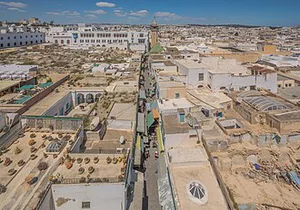
You step through Bab El Bhar, the great gate that separates the modern French Quarter from another world. Within seconds, the city’s noise drops to a hum, the light narrows into golden shafts, and you’re swallowed by a labyrinth that has barely changed in a thousand years. This is the Medina of Tunis, a living, breathing medieval city that doesn’t feel like a museum – because it isn’t one. It’s a place where a 14th-century fountain still pours water, where the smell of mint, leather, and rosewater fights for your attention, and where barefoot kids weave between donkeys carrying sacks of spices. Founded in the 7th century, this is the absolute core of Tunisia’s capital, a UNESCO World Heritage Site that thrives on chaos, history, and hand-to-hand commerce.
What makes it truly magical is the way the past and present collide. You’ll be walking through a cool, vaulted souk built for merchants from another century, and suddenly your phone buzzes with a delivery notification. Old men in wool caps play checkers on a tiled step while a few meters away, a woman in a modern abaya haggles fiercely for a pair of hand-stitched babouches. The medina isn’t a relic; it’s a crowded, noisy, glittering heart. And once you’re inside its twisting streets, you’ll find that getting lost isn’t a problem – it’s the whole point.
The story begins long before Tunis was ever a great capital. In the 7th century, Arab armies swept through North Africa and built a settlement near the ancient ruins of Carthage. The brilliant and ruthless Aghlabid dynasty soon made it a power center, but it was the 12th and 13th centuries, under the Almohads and then the Hafsids, that truly transformed this place. Tunis became a glittering hub of trade between Europe, Africa, and the Middle East. Merchants from Pisa, Genoa, and Granada crowded its docks, while scholars and poets flocked to the Zitouna Mosque, one of the oldest and most venerated universities in the Islamic world. At its peak, the medina hosted over 200,000 people, a staggering number for the medieval era.
The city’s golden age under the Hafsids is carved into every archway and dome you’ll see. That famous black-and-white stone, the dazzling zellige tiles, the honeycombed cedar ceilings – much of it dates from this period. But the medina also bears the fingerprints of the Ottomans, who arrived in 1574 and ruled for three centuries. They added ornately tiled minarets, grand palaces, and those distinctive round-topped mausoleums that pepper the skyline. When the French colonialists arrived in the late 19th century, they built their new city just outside the walls, and here’s the beautiful irony: because the French moved out, the medina was frozen in time. It was left to the locals, the traders, and the craftsmen. In 1979, UNESCO recognized it for what it is – an exceptionally well-preserved example of a great Arab-Islamic city, still very much alive.
Now, let’s get you inside. There’s no single ticket for the medina itself – it’s an open, living quarter, and that’s part of its charm. But you’ll want to budget for the handful of monuments that charge a small entrance fee (typically a few dinars). The absolute must-see is the Great Mosque, or Zitouna. Its towering minaret is a landmark, but the courtyard, with its forest of ancient columns reused from Roman Carthage, is breathtaking. Non-Muslims can’t go into the prayer hall itself, but you can respectfully peek at the courtyard’s elegance. From there, plunge into Souk El Attarine, the perfume and traditional crafts market. It’s the most visually stunning, with its roofed, filtered light and stacked shelves of amber, jasmine, and glass bottles. Follow your nose.
Time flies here. The medina isn’t a quick browse; it demands at least half a day to properly soak it in. If you have a full day, even better. You’ll want to lose yourself in the main souks – the Souk des Étoffes is a riot of silk and wool. Then, break for a mint tea on a rooftop café terrace (look for signs pointing to the panoramic views near the mosque). But don’t just stick to the main arteries. Wander into the side alleys, and you’ll find hidden courtyards, carved wooden doors, and the soothing trickle of a public fountain. For a true hidden gem, seek out Dar Ben Abdallah, a restored 18th-century palace that’s now a small museum of daily life. It’s a quiet, cool oasis with a magnificent painted ceiling and painted walls depicting scenes of corsair-era Tunis. You’ll probably have the place almost to yourself.
For photography, the angle matters. The best shots aren’t at the wide, obvious squares; they’re in the narrow, vaulted passages where streaks of light slash across the cobblestones. Head to the steps near Bab Bédji believe it or not, the rooftop of the Café M’Rabet offers a stunning panorama of the old city’s tangled rooftops and satellite dishes. For a classic shot, frame the ornate minaret of the Zitouna Mosque from a narrow alley that leads to the souk. And don’t be shy about shooting doorways – the heavy, nail-studded wooden doors with their brass knockers are works of art in themselves. Just remember to ask before photographing shopkeepers or their goods; a friendly hand gesture works wonders.
Now, about hidden gems: the medina is peppered with hammams, and if you’re brave enough to embrace local culture, a visit to Hammam El Jazira is an unforgettable experience. It’s not a tourist trap; it’s a steamy, tiled, centuries-old bathhouse where men and women have separate hours. Go for the authentic scrub and massage – but bring your own soap and slippers. Another secret is the Sidi Youssef Sahib shrine, a little-visited masterpiece of Turkish-inspired tile work. Finally, don’t miss the fondouks. These are old merchant inns built around huge courtyards, where camels and pack mules once slept on the ground floor. Some are crumbling, some are warehouses, but all are hauntingly beautiful. Step into Fondouk El-Attarine and just stand there for a minute, listening to the quiet echo of a thousand years of trade. That’s the real medina, the one between the shops, the one that lives in the stones.
A final word: this is a place of wares, and you’ll be invited into plenty of carpets and leather shops. A smile and a firm ‘no thank you’ is perfectly fine. But talkative shopkeepers can reveal the city’s secrets, so strike up a conversation if you have time. The medina is also a place to slow down. Sit by the fountain at Place du Tribunal, watch the sparrows, sip your coffee. You’re not just visiting an old city; you’re stepping into a living tradition that respects the past every single day. Just remember to keep one eye on your pockets in the busiest crowded sections – it’s a tolerant place, but savvy travelers know to keep their belongings close. Take your time, trust your instincts, and let the labyrinth work its magic. You’ll leave with dusty shoes, a head full of images, and the scent of spices clinging to your clothes – and you’ll already be planning your return.
