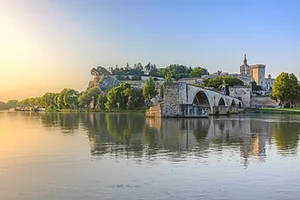
Picture this: you’re strolling along the Rhône River in the south of France, the golden stone of Avignon glowing in the afternoon light. Then you see it—a bridge that doesn’t quite make it across. It starts strong from the city wall, leaps over one arch, then another, and then simply stops mid-river, as if the builders just gave up and went home for a glass of rosé. This is the Pont Saint-Bénézet, better known to the world as the bridge of the famous nursery rhyme “Sur le Pont d’Avignon.”
But don’t let the song fool you. The real bridge is not a place where everyone danced in circles. It’s far more melancholic and thrilling than that. It’s a stone skeleton of what was once one of Europe’s great crossings—a feat of medieval engineering that defied a raging river for centuries. And today, it’s a spot where you can stand on the edge of history, feel the wind in your hair, and watch the Rhône race beneath your feet, carrying centuries of stories with it.
What makes this bridge so unforgettable isn’t just its structure, but its character. It’s a bridge with a broken heart, a monument to both human ambition and the stubborn power of nature. You won’t find a grand, unbroken span here—you’ll find something far more evocative. You’ll find the end of a journey, frozen in time.
The story begins in 1177, when a young shepherd named Bénézet claimed he received a vision from God to build a bridge across the Rhône. He was mocked, of course—who wouldn’t laugh at a shepherd boy with such a wild dream? But according to legend, Bénézet miraculously lifted a massive stone block that no one else could move, and that was enough to convince the officials. They gave him land and money, and construction began. It’s a beautiful, almost impossible story, and that’s probably just how the boy liked it.
The bridge was no small project. It took nearly eight years to complete, spanning more than 900 meters with 22 arches. It linked Avignon—then part of the Papal States—with the Holy Roman Empire across the river, making it a vital artery for pilgrims, merchants, and armies. For centuries, it was the only fixed crossing of the Rhône between Lyon and the Mediterranean Sea. Tolls were collected, taxes levied, and the bridge made Avignon rich. But the river had other ideas.
The Rhône is not a gentle stream. It’s a ferocious, glacier-fed giant that swells with snowmelt in spring and explodes after heavy rain. The bridge was damaged and rebuilt so many times that locals must have lost count. Floods took out arches, and replacement wood and stone never quite held. By the 17th century, after a particularly devastating flood in 1668 swept away half the bridge, the people of Avignon decided enough was enough. They abandoned it, letting the remains crumble into the river. Today, only four of the original 22 arches survive, and even those have been patched and rebuilt so many times that they’re more like a collage of different centuries than a single original structure.
What’s left is still breathtaking. As you walk up the ramp and onto the bridge itself, you’re treading on the same worn stones that pilgrims, popes, and peasants used eight hundred years ago. The bridge is wide enough to give you a sense of purpose, yet narrow enough to make you feel how vulnerable people were up here, exposed to the elements and the thunderous water below. At the end, you come face to face with the famous break—a clean, abrupt cliff of masonry where the bridge just… stops.
There are two small structures on the bridge that you can actually go inside, and they’re easy to miss if you’re not paying attention. One is the chapel of Saint Nicholas, a tiny Romanesque gem that has been restored and now houses a small exhibition about the bridge’s history. It’s a hushed, cool space that smells of old stone and candle wax, and it feels like stepping into a forgotten pocket of the Middle Ages. Another chapel, dedicated to Saint Bénézet himself, sits on the river side of the upper level, though it’s often closed to the public. But even peering through its gate gives you a sense of the devotion that once animated this place.
From the end of the bridge, you have one of the most striking views in all of Avignon. Look back, and you’ll see the mighty Rocher des Doms with its gardens towering over the city, and the Palais des Papes looming just behind, like a grand medieval castle perpetually watching your every step. Look across the river, and you’ll spot the Tour Philippe-le-Bel on the other bank, the ghostly twin tower that was part of the bridge’s original fortifications. It’s a perfect place to linger for a few minutes, listening to the water and imagining boats, barges, and swans gliding through the arches that are no longer there.
As for your visit, plan to spend about 45 minutes to an hour here. It’s not a sprawling site—the bridge is just 120 meters long in its surviving section—but the experience rewards a little patience. Walk up and down the span, read the informational panels, and take your time in the chapel. The ticket also includes access to the gardens of the Rocher des Doms, which is actually a much bigger treat than it sounds. From those gardens, you get an entirely different perspective—looking down on the bridge from above, with the entire city and river laid out like a painting.
When it comes to photos, the money shot is from the end of the bridge, where you can capture the abrupt cutoff with the river stretching beyond it. Try to go in the early morning or late afternoon, when the soft light turns the stone a warm honey color and the crowds are thinner. Another underrated spot is from the riverbank just below the bridge, where you can frame the four arches with the Avignon skyline behind them. And if you’re lucky enough to visit during a mistral wind storm—the powerful northern wind that shapes life in Provence—you’ll get the full dramatic effect: the bridge rising like a ship’s bow into a churning sky.
One hidden gem most visitors miss is the small staircase inside the ramparts at the bridge’s entrance. It leads down to a tiny, almost secret viewing platform right at the water’s edge. From here, you can hear the river splashing against the ancient stone, and you’ll realize just how enormous those arches really are. It’s a thrillingly intimate view of a place that usually seems so distant. Also, keep an eye out for subtle carvings on some of the old stones—marks left by medieval medieval masons centuries ago, tiny signatures in the rock.
Tickets are not expensive, and you can book them on-site or online. The bridge is open year-round, though hours shift with the seasons, and it’s closed on some holidays. If you’re already planning to visit the Palais des Papes, grab the combined ticket for the two monuments—it’ll save you time and money. But even on its own, the Pont Saint-Bénézet is utterly worth it. It’s a place that makes you think about time, ambition, and the beautiful futility of trying to tame a river.
In the end, this broken bridge has become something more perfect than a whole one could ever be. It’s a memory, a song, a legend you can actually walk on. When you stand at its sudden end, with the entire width of the Rhône rushing past you, you’ll understand why this half-finished crossing still draws people from all corners of the globe. Because sometimes the most inspiring stories aren’t the ones that end successfully. Sometimes they’re the ones that just—stop, and leave us wondering what could have been.
