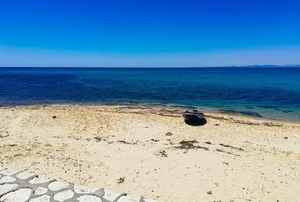
The first thing you notice about Hammamet is the scent. It hangs in the warm air like a greeting – sweet, heady jasmine woven through the salt of the Mediterranean. Then you see the whites. Not just the whitewash of the medina’s walls, but the startling white of everything against an impossibly blue sky. This is Tunisia’s original resort town, a place that’s charmed visitors for over a century, and it still knows exactly how to make a first impression.
The medina spills toward the sea like a sugar cube melting into the waves. Its old city walls, honey-colored and crumbling in places, enclose a labyrinth of alleyways where cats doze on sun-warmed steps and the smell of mint tea drifts from hidden doorways. Beyond the ramparts, luxurious gardens tumble down to sandy coves. For decades, Hammamet has been the country’s playground – a spot where artists, writers, and wanderers came looking for light, and found it in blinding abundance.
You don’t just visit Hammamet. You slip into it, like a pair of worn leather sandals. It’s a place that rewards slow wandering, where the distinction between past and present blurs. Whether you’re here for the history, the beach, or simply to watch the sunset set the fort on fire, you’ll understand why the Tunisians call it ‘The Garden of Paradise.’
Long before the tourists arrived, Hammamet was a strategic outpost. The Romans had a settlement nearby called Pupput, but the town as we know it really took shape in the 9th century. Around 821 AD, the Aghlabid dynasty built a ribat – a fortified monastery that served both as a religious retreat and a defensive stronghold against Byzantine raids. That ribat still stands today, its watchtowers gazing out over the sea, a sentinel that’s seen a thousand sail changes.
The medina’s walls you see today were added in the 13th century, under the Hafsid dynasty, and later reinforced by the Ottomans in the 1600s. For centuries, Hammamet operated as a quiet trading port. It was also a haven for pirates, who found the shallow coast perfect for their swift vessels. But the town’s modern fate was sealed in the 1920s, when a Romanian exile named George Sebastian built a lavish villa just outside the old city. That villa, with its blend of Andalusian, Moorish, and modernist styles, attracted a glittering crowd – figures like Frank Lloyd Wright, Truman Capote, and Sophia Loren. Their presence put Hammamet on the international map, transforming a sleepy coastal town into a glamorous escape. The villa is now the Centre Culturel International, a quiet whisper of that rarefied era.
Start your visit in the ribat. Climb its narrow, steep steps to the rooftop, and you’ll earn one of the best panoramas in town – the medina’s flat rooftops on one side, the glittering bay on the other. It’s a short walk from the ribat to the fort, or kasbah, which anchors the southwestern corner of the medina. The kasbah is more than a postcard. Inside its thick walls, you’ll find a small museum with artifacts from the Roman era, including mosaics and marble relics from Pupput. The fort’s ramparts are the place to be at golden hour, when the light turns every wall to honey.
Within the medina itself, just let yourself get lost. The main streets are lined with shops selling ceramics, leather, and fluffy pastel sweaters, but turn down any side alley and you’ll find quiet courtyards and faded doorways. Don’t miss the Great Mosque, with its elegant minaret – visitors are welcome to admire it from the outside, and you’ll likely have the street to yourself. Also look for the mausoleum of Sidi Bou Hdid, the town’s patron saint, tucked near the walls; it’s a serene, whitewashed shrine where locals still come to pay their respects. This is one of those hidden gems that tour groups race past, and that’s precisely why you should linger.
A few steps outside the medina’s main gate lies the George Sebastian villa. The lush garden is a masterpiece itself, with bougainvillea, olive trees, and cypress creating a cool, shaded refuge. The villa’s interior hosts rotating art exhibitions, but the architecture is the real star – horseshoe arches, carved plaster, and sky-blue tiles that seem to glow. It’s a short, pleasant walk from the medina, and well worth the modest entry fee.
How long do you need? Give Hammamet at least half a day to do its magic. If you’re a slow traveler, a full day will fly by – especially if you pause for a mint tea at a café on the fort square, or dip your toes in the water at the small beach just below the medina walls. That beach isn’t Hammamet’s finest – the more famous sandy stretches stretch north toward Yasmine Hammamet – but it’s wonderfully local, with fishermen mending nets and old men playing cards in the shade.
For ticket information, know this: the ribat and the kasbah each charge a small fee (around 8-10 Tunisian dinars), and they’re usually bundled on a combined ticket. The George Sebastian villa has its own ticket, also modest. The medina itself is free – wander to your heart’s content. Cash is king here; the small ticket booths often don’t accept cards, so bring a few small notes.
As for photo spots, the obvious winner is the kasbah ramparts at sunset, with the medina’s domes and minaret silhouetted before you. But for a different angle, head to the little pier on the western side of the harbor. From there, you get the entire medina, including the fort, reflected in the calm water. And here’s a secret: the rooftop of Café Sidi Bou Hdid, a tiny spot tucked into the medina walls, gives you a bird’s-eye view of the town’s daily rhythm that no postcard can capture.
Hammamet is a place that doesn’t shout. It whispers, hums, and eventually settles into your bones. The jasmine scent follows you through the alleys, the sea light fills your camera roll, and long after you’ve left, you’ll find yourself thinking of those white walls against that blue sky. It’s an old story, but it never gets old.
