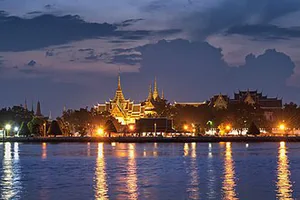
Step through the Emerald Gate and you’ll be catapulted into a world where gold and glitter are the norm, not the exception. The Grand Palace of Bangkok isn’t a single building – it’s a sprawling compound of spires, temples, pavilions, and courtyards that seems to defy both gravity and reason. Sunlight dances on thousands of tiny glass mosaics and porcelain fragments, while giant demon-guardians loom at every corner, their fierce eyes watching you from beneath layers of myth and history.
This is Thailand’s most sacred and spectacular landmark. For well over two centuries, it’s served as the official residence of the kings of Siam, the spiritual home of the Emerald Buddha, and the stage for rites and rituals that still shape Thai life today. Words like “beautiful” or “breathtaking” feel inadequate here. The Grand Palace must be experienced, not just read about – its magic is in the way the light catches a golden chedi or the fragrance of jasmine drifting from a shrine.
The palace’s story begins in 1782, when King Rama I decided to move the capital across the Chao Phraya River from Thonburi to Bangkok. After the fall of Ayutthaya to Burmese forces, the new king wanted nothing less than a city that symbolized the dawn of a new, glorious era. So he commissioned a grand royal complex on land formerly inhabited by a Chinese merchant community – and the Grand Palace was born. It wasn’t just a home; it was a microcosm of the universe, a physical manifestation of the king’s cosmic power. Later monarchs, especially Rama IV and Rama V, added Western touches, mixing Baroque pillars and Victorian filigree with traditional Thai roofing and cherry-red gables.
The heart of the palace isn’t a throne room, but a temple: Wat Phra Kaew, the Temple of the Emerald Buddha. The statue itself – carved from a single block of jade and only about 66 centimeters tall – has a legend-drenched past. It was discovered after lightning struck a pagoda in 1434, then moved between Chiang Rai, Lampang, Chiang Mai, and Luang Prabang, finally landing in Vientiane, where it was taken by a Siamese general in 1778. Rama I brought it to Bangkok and enshrined it here. Ever since, the king (or as today, his representative) dresses the Buddha in seasonal robes three times a year. This tiny statue, perched high on an ornate altar, is the true soul of Thailand.
When you visit, set aside a solid half-day – three to four hours if you want to do more than just snap a couple of selfies. The dress code is strict: long pants and sleeves past your shoulders for everyone. No, really. If you’re wearing shorts, a skirt, or a tank top, you’ll be made to rent a proper sarong from the booth near the entrance. Shoes come off at every temple entrance, so slip-ons are your best friend. The ticket booth is at the main entrance; it costs 500 baht (roughly $14) and includes a visitor’s guide booklet in English, which actually helps decode all that symbolism.
Entering the compound, the first thing you’ll see is Wat Phra Kaew’s sheer spectacle. The golden chedi, supposedly containing a relic of the Buddha, towers over the plaza. To your left, the Phra Mondop library holds sacred scriptures on mother-of-pearl inlaid shelves. After that, wander the long gallery that rings the inner courtyard – the Ramakien murals stretch for over a kilometer and tell the entire epic of the monkey king Hanuman in hundreds of vividly colored scenes. Most people miss the intricate model of Angkor Wat tucked away by the gallery, a fascinating gift from King Rama IV to display his kingdom’s ancient glory.
For photography, the classic shot is the golden chedi with its blue-tiled base and jingling bells, but for a fresh angle, walk past the clock tower and shoot toward the chedi’s reflection in the pond near the model of Angkor Wat. Inside the Temple of the Emerald Buddha itself, you’re not allowed to take pictures – respectful visitors accept this and simply soak in the atmosphere. The outer gates are guarded by giant mythical creatures called yakshas holding golden clubs, and they make for dramatic foreground subjects. And remember: you don’t have to follow the crowds in a circle. There are quieter corners along the northern edge of the compound, where you’ll find less foot traffic and more chance to listen to the wind in the bells.
Let me let you in on a hidden gem: the Royal Pantheon, called Prasat Phra Debidorn. It’s shut for almost the entire year, opening only on the birthday of King Rama I in April. But even from the outside, its ornate friezes and Corinthian columns tell a story of cultural fusion. Another lesser-known treat is the line of Chinese stone statues and bronze cranes scattered around the base of the terraces – these were shipped to Thailand as ballast in trade ships centuries ago, “stone cargo” that became silent guardians. When you’ve had your fill of gold and jade, take a breath, find a shaded bench, and just watch the palace guards in their pristine white uniforms, perfectly still, as if time itself has stopped for a moment.
