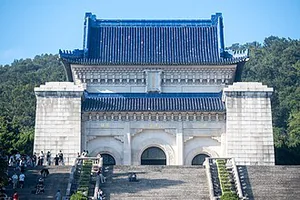
At the southern foot of Nanjing’s Purple Mountain, a long line of pale-grey steps climbs into a forest of cedar and cypress, ending at a snow-white archway and a blue-tiled gateway. That regal deep-blue roof, set against the evergreen hillside, belongs to one of China’s most stirring landmarks: the Sun Yat-sen Mausoleum. It was never a palace or a temple, but a tomb—the final resting place of the man who helped end a two-thousand-year reign of emperors and, in doing so, set modern China on its course.
Even if you haven’t studied Chinese history, you’ll probably know the name. Sun Yat-sen is celebrated on both sides of the Taiwan Strait as the country’s founding father. His Three Principles of the People—nationalism, democracy, and people’s livelihood—shaped the Republic of China and still influence the mainland’s own sense of identity. But the mausoleum itself is the real star. It doesn’t shout; it invites. You walk upward through a long processional corridor that becomes steeper with every flight, watching the sky widen, listening to the wind rustle through the pines. By the time you reach the top, your legs feel it, and your chest feels something too. That’s the design working on you.
Sun Yat-sen was born in 1866, a time when China was buckling under dynastic decay and foreign pressure. He spent years traveling the world, converting Chinese émigrés to his revolutionary cause, and on a hopeful October night in 1911, his supporters triggered the Wuchang Uprising that toppled the Qing dynasty. He was named provisional president of the new Republic of China, but the revolution’s early optimism soon faded. He spent his final years in Guangdong and Beijing, still dreaming of a unified country when he died of liver cancer in March 1925.
He didn’t specify exactly where he wanted to be buried, but he had once remarked, on passing Nanjing’s Purple Mountain, how he would like to rest there. The new government took him at his word. The young architect Lü Yanzhi, who had studied at Cornell and returned to China, submitted a design that has been described as the shape of an upside-down bell—an ancient Chinese symbol of freedom and awakening. Construction began in January 1926. The body lay in a temporary temple in Beijing’s Western Hills while workers hauled stone and earth up the mountain, carving those 392 steps and erecting the three-arch paifang at the bottom.
When the mausoleum was finally dedicated in June 1929, Sun Yat-sen’s coffin was drawn by railway across the country to Nanjing, then conveyed up the hill for a grand ceremony. In the years after, the site survived war, political upheaval, and the Cultural Revolution when many other tombs were smashed. The mausoleum became a pilgrimage site for mainlanders and Taiwanese alike. Today, nearly a century on, it remains one of the spiritual anchors of modern China.
Begin at the wide berth of the starting plaza. You’ll pass a three-arched granite gate with President Sun’s own words, “The world belongs to the people,” carved across it. Beyond that, the path lengthens, climbing gently past rows of emblematic cedars. Don’t rush. The view behind you is worth a few backward glances—the gray-crowned rooftops of Nanjing unfolding into the valley.
The stairway is the heart of the experience. There are 392 steps in eight broad platforms, and every stretch feels different from the last. On a clear morning, sunlight slices across the white masonry; on a humid afternoon, the stone radiates heat and the shade of the side trees feels like a reward. The climb builds anticipation for the main hall, where a seated bronze statue of Sun Yat-sen holds a scroll in his lap. The room is quiet, purposely solemn, the blue roof and white walls repeating across the ceiling. A monument stands behind the statue, and a circular tomb chamber beyond it holds a marble likeness of the leader lying on a plinth. Cameras are not your friend here—put them away and just let the place hang around you for a minute.
As for timing, plan to spend a good three hours if you only wander the main axis. You could double that if you’re the kind of visitor who pauses to read every inscription. For the best light and the smallest crowds, arrive when the gates open in the morning or go late on a weekday. The mausoleum itself is free, but you’ll need to reserve a time slot in advance—you can do it online with your passport. The surrounding forest park charges a small ticket fee, and if you want to see nearby attractions like Linggu Temple or the Ming Xiaoling Mausoleum, bring a little extra cash.
Your finest photo is at the top, turned back toward the gate, so the steps tumble down like a white waterfall between dark pines. Another classic shot is up from the bottom paifang, the blue gateway framed in the arch. But the hidden gem most people miss is a small, modestly signed path to the east of the main hall, where the original construction offices stood. It’s a quiet spot with the same blue-and-white palette, and almost nobody walks there. If you’ve ever wondered what a tomb should feel like—not scary, not solemn to the point of gloom, but deeply peaceful—it’s this. The mausoleum hums with something bigger than one man. It hums with the idea that a people could choose their own fate, and build a staircase to mark it.
