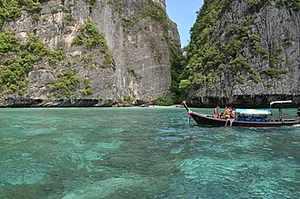
Imagine water so clear it looks like liquid glass, cliffs that punch straight up from the sea like ancient stone sentinels, and longtail boats carving white crescents across a bay of impossible blue. That’s the Phi Phi Islands. This is Thailand’s poster child for tropical perfection, and honestly, the postcards don’t exaggerate one bit.
The archipelago sits in the Andaman Sea as a six-island cluster, though only two really matter to travelers: Phi Phi Don and Phi Phi Leh. Phi Phi Don is the beating heart, a narrow landmass shaped like a figure-eight, pinched in the middle by two sweeping bays. Phi Phi Leh, on the other hand, is the showstopper — a fortress of limestone karst that hides Maya Bay inside its rocky embrace. That’s the cove made world-famous by the 2000 film ‘The Beach,’ and if you’ve ever stared at a photo of it and wondered if it’s real, the answer is yes. The reality somehow beats the pixels.
For decades, these islands lured travelers with a simple promise: escape. You’d round a headland, and the world’s noise would just drop away, replaced by the hum of a longtail engine and the lap of warm water against sand. The crowds found their way here eventually, sure, but the place still delivers that gut-punch of beauty you simply can’t manufacture.
The name ‘Phi Phi’ sounds vaguely ghostly — in Thai, ‘phi’ does translate to spirit — but linguists figure it’s really a mangled version of the Malay word ‘pulau,’ meaning island. Whatever the origin, the islands remained a quiet afterthought for centuries, used primarily by the Chao Leh, or sea gypsies, who navigated the Andaman’s monsoon rhythms long before resorts existed. They knew these sheltered bays as home, not as a destination.
The modern era kicked off in 1983 when the islands were declared a marine national park. For a while, Phi Phi Don stayed a sleepy backpacker secret. Then ‘The Beach’ came along, filmed at Maya Bay in 1999 and released to global fanfare in 2000. Overnight, a pristine little cove turned into a pilgrimage site, and the islands found themselves on every traveler’s wish list, from gap-year students to honeymooners.
But paradise faced its darkest hour on December 26, 2004, when the Indian Ocean tsunami slammed into the islands. The wave flattened much of Phi Phi Don’s infrastructure and claimed hundreds of lives. Recovery was slow, painful, and deeply personal for the locals who rebuilt from rubble. Then came a different kind of crisis: overtourism. By 2018, Maya Bay’s coral reefs were dying under the weight of thousands of daily visitors. Officials made the bold call to shut the bay entirely, sparking global debate. When it finally reopened in 2022, it came with strict rules — no boats in the bay, limited time slots, and a hard cap on visitor numbers. That careful management is what keeps the magic alive today.
Start your exploring at Maya Bay on Phi Phi Leh, because that’s the reason everyone shows up. Boats now moor at a floating dock outside the bay, and you walk through a dramatic cleft in the rock to reach the sand. The effect is pure cinema: a crescent of white beach framed by towering cliffs, the water glowing in layered shades of jade and turquoise. You’ll get about an hour, and you’ll share it with other travelers, but the sheer scale of the place swallows the crowd. After Maya Bay, hop back on the boat and head to Pileh Lagoon, a narrow channel where the water turns an almost supernatural azure. Locals call it ‘the swimming pool,’ and the moment you slip in, you’ll understand exactly why.
Don’t skip the viewpoint hike on Phi Phi Don, either. It’s steep, sweaty, and absolutely worth it. A twenty-to-thirty-minute climb brings you to a panoramic overlook where the island’s two bays — Ton Sai and Loh Dalum — curve around the landmass like parentheses. Time it so you’re at the top as the sun begins its golden descent, and you’ll shoot the shot that makes your friends back home seriously jealous. For a more mellow scene, the island’s east side offers the tidal sandbar at Laem Thong, where you can walk across to a tiny islet at low tide, as well as the gentle shallows of Long Beach.
How much time should you budget? A day trip scratches the surface, but it’s a surface worth scratching. Two days and one night is the real sweet spot — it lets you experience Phi Phi Leh in the early morning before the tour boats arrive, climb the viewpoint at sunset, and snorkel at your own lazy pace. A national park entrance fee applies, roughly 400 baht for adults and 200 baht for kids, collected at designated points. Bring cash and keep it accessible; there are no ATMs on Phi Phi Leh, and the rangers enforce the fee before you reach the beach. Think of it as a subscription to paradise, and you’ll happily pay.
For those who want to wander off the beaten path, hire a longtail around to Loh Lana Bay on the island’s northern edge — a hushed stretch of sand where you’re more likely to hear birds than boat engines. Monkey Beach on Phi Phi Don has its share of curious macaques, but keep your snacks buried in your bag; they’re notorious thieves. And if you’re keen on underwater encounters, the coral gardens at Shark Point, near Phi Phi Leh, are where blacktip reef sharks glide through the shallows. They’re shy and harmless — spotting one is a memory you’ll carry for years. The islands have survived a tsunami, a pandemic, and a tourist boom gone sideways. Yet after all of that, this scatter of limestone and sand remains one of Thailand’s most magnetic destinations. Don’t overthink it. Come early, stay a while, and let the Andaman Sea work its magic.
