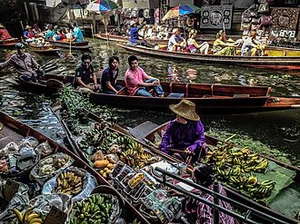
The first thing that hits you is the color. Long-tailed boats painted in electric blues and reds jostle for space on a khlong so narrow you could almost reach out and touch the boat next to you. Then comes the sound—the low putter of outboard motors, the splash of wooden paddles, and the singsong calls of vendors hawking their wares. You’re not just visiting a market; you’re stepping into a living, breathing postcard. This is Damnoen Saduak, Thailand’s most famous floating market, and it’s a full-on assault on every sense.
For decades, this watery bazaar has drawn travelers from every corner of the globe. It’s a place where tradition and tourism dance a delicate tango. Yes, it can be crowded. Yes, it’s undeniably touristy. But that doesn’t make it any less magical. Because here, on the canals southwest of Bangkok, you’ll find a version of Thailand that feels both timeless and utterly alive. Wooden boats piled high with pyramids of vibrant tropical fruit glide past women in wide-brimmed straw hats, their faces weathered by years of sun and river spray. The air smells of coconut milk, grilled meat, and sweet jasmine. It’s chaotic, it’s overwhelming, and it’s absolutely unforgettable.
The story of Damnoen Saduak begins not with tourism, but with water management. Back in the mid-19th century, King Rama IV (Mongkut) ordered the digging of a network of canals to connect the Mae Klong River with the Tha Chin River. The aim was simple: create an irrigation system and a faster route for trade and travel. The main canal, Khlong Damnoen Saduak, was completed in 1868, the same year Rama V ascended the throne. The name translates to ‘a place where travelers can go by boat,’ and that’s exactly what it became.
For generations, local farmers used these canals to transport rice, vegetables, and fruits from their fields to markets in nearby towns. They’d load their wooden sampans at dawn and paddle to meet other traders at intersection points. Over time, these meeting spots grew into informal markets. Boats became shops, and the waterways became streets. The community that developed around the khlong relied on this watery highway for everything—food, supplies, and connection. It was a way of life, not an attraction.
That all changed in the 1970s. As Bangkok modernized and roads arrived, many traditional floating markets faded away. But Damnoen Saduak, with its picture-perfect scenery and vibrant atmosphere, caught the eye of international tour operators. It quickly transformed from a local trading post into a global icon. Today, the market is a managed attraction, but the beating heart of its history still pulses just beneath the surface. The vendors—many of them the children and grandchildren of the original traders—keep the old ways alive. They still live along the canals, still grow their own produce, and still know the water like the back of their hands.
So, what should you actually do once you’re there? First, rent a paddle boat or a motorized longtail. You’ll want an early start—the market peaks between 7 and 9 a.m., so arrive as close to opening as you can manage. Glide through the main khlong and let the frenzy wash over you. Vendors will hook your boat with a pole to pull you closer to their floating shop. It’s all part of the dance. Don’t worry about being trapped; a polite smile and a ‘mai ow krap’ (no, thanks) will set you free.
Inside the market, your taste buds are in for a ride. Grab a bowl of boat noodles from a vendor who cooks right on their boat—the broth is rich, spicy, and utterly fragrant. Or try fresh coconut ice cream served in a coconut shell, topped with peanuts and sweet rice. For a more substantial bite, look for the legendary mango sticky rice, or grilled river prawns the size of your hand. The food here is the real deal, made with love and a lifetime of skill. Just be prepared to eat with your elbows out, balancing your bowl on your knee as the boat bobs gently beneath you.
As for time and money, here’s the deal. You don’t pay an entry fee to visit the market itself. You’ll only pay for your boat ride, which is typically arranged by one of the tour operators at the entrance. A shared longtail tour costs around 200–300 baht per person and lasts roughly an hour. That’s enough time to get a solid taste of the main action. If you want a more intimate experience, skip the motor and rent a paddle boat for about the same price. It’s slower, but you can drift at your own pace and you’ll get close to the action without the roar of an engine.
Now, let’s talk about photo spots. The best angles aren’t always the obvious ones. Yes, the main canal is photogenic, but for a truly magical shot, duck into a smaller side canal. There, you’ll see fewer tourists and more locals—women washing dishes off the backs of their homes, kids jumping into the water. The soft morning light glancing off the water, with a vendor in a straw hat rowing past, is pure gold. Another secret: climb onto the wooden bridge near the center of the market. From that vantage point, you can capture the entire chaotic symphony below—boats crisscrossing, paddles flashing, and colors swirling together.
If you look past the souvenir stalls, you’ll find hidden gems. There’s a small Buddhist shrine tucked away in one of the dead-end canals, where boat owners stop to make a quick offering of incense and flowers. Watch for the floating fruit sellers who pad their boats with fresh coconuts and mangosteens from their own orchards—they’re the true guardians of the old way. And if you wander to the far end of the market, you’ll discover a quieter section where locals still buy their daily provisions. There, you can see the market functioning as it did decades ago, without a camera phone in sight.
Finally, a word on etiquette. The market is a working community, not just a theme park. Be respectful with your camera—ask before snapping a close-up of a vendor’s face. Keep your hands and feet inside the boat, and don’t try to climb aboard someone’s store. And for goodness’ sake, hold on to your hat. The breeze from passing boats has stolen more than one. If you follow those rules, you’ll leave Damnoen Saduak with not just photos, but a genuine feel for a world that floats gently between past and present. It’s messy, loud, delicious, and weirdly beautiful—a place you’ll never forget.
