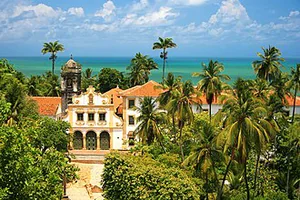
Perched on a forested hill above the Atlantic, Olinda is the kind of place that makes you want to put your camera down and just stare. From its historic belvederes, the old town unfolds like a living canvas: colonial churches poking through lush greenery, pastel-colored houses tumbling down cobblestone lanes, and, in the distance, the glittering curve of Recife’s coastline. But Olinda isn’t just a pretty postcard. It’s a city that hums with creativity, where the scent of drying paint mingles with the aroma of acarajé frying on street corners, and where every doorway seems to lead to a studio, a gallery, or a very loud conversation about art.
This place has a pulse, and you feel it the moment you step onto its uneven stone streets. One minute you’re marveling at a 16th-century monastery, the next you’re swept up in the thrum of musicians rehearsing for Carnaval. Olinda is famous for its dazzling Carnival—a wild, democratic street party where giant puppets tower over the crowd and everyone dances until dawn—but that’s only part of the story. The rest is a quiet, layered beauty that rewards slow wandering. It’s a Unesco World Heritage site, yes, but it’s also a living neighborhood, not a museum piece.
To walk through Olinda is to walk through Brazilian history with your shoes on. The city was founded in 1535 by Duarte Coelho, a Portuguese nobleman who saw the hill’s strategic promise. Within a couple of decades, it had become one of the most prosperous sugar-producing colonies in the world, and its wealthy landowners financed a skyline of grand churches and mansions. At its peak, Olinda was so rich that locals reportedly used gold thread in their fishing nets—an extravagance that made the Dutch take notice. In 1630, the Dutch West India Company invaded, and after a bitter struggle, they burned the town in 1654 as they were driven out. The Portuguese rebuilt, but Olinda never regained its commercial dominance; that crown passed to nearby Recife. That turn of fortune turned out to be a gift. With little money for modernization, Olinda kept its colonial bones intact.
The 20th century brought a different kind of rebirth. In the 1960s and 70s, artists and bohemians moved into the crumbling houses, lured by cheap rent and incredible light. They opened galleries, started workshops, and revived the town’s crafts tradition—brightly colored woodcuts, clay figurines, and the famous giant puppets called bonecos, which now lead Carnival processions. Unesco recognized Olinda’s architectural and cultural value in 1982, and the designation helped fund decades of careful restoration. Today, the hilltop feels like a bridge between eras, where sacred baroque art hangs meters from quirky modern sculptures, and where a monk’s meditation garden sits around the corner from a tattoo studio. Still, it’s not a place stuck in the past. New generations of artists keep reinventing it, and that’s exactly why so many visitors find it endlessly magnetic.
Begin your tour at the Alto da Sé, the plaza that marks the top of the old town and the site of the original settlement. The view alone is worth the climb—a sweeping panorama of Recife’s skyscrapers, the Atlantic Ocean, and a jumble of red-tiled rooftops. Right beside it stands the Sé Church, the town’s first cathedral, though what you see today is mostly a 19th-century renovation. Step inside for a moment of calm, then come back out and wander downhill along Rua São Bento. You’ll pass the Monastery of São Bento, a 16th-century gem whose gold-leafed chapel glows like a jewel box. Mass is open to the public and the monks’ Gregorian chants are hauntingly beautiful—check the schedule if you’d like to hear them. Further down, the Convent of São Francisco features a lavish azulejo-tiled cloister and a small museum. It’s easy to lose track of time here, so plan to stay for at least half a day. If you’re a museum person, a full day will pass in a heartbeat.
Tickets aren’t the main event in Olinda. Most public areas, including the plazas and the belvedere, are free to explore. A few churches and museums ask for a modest donation or charge a small entrance fee—usually less than 10 reais. The religious sites have their own opening hours, often closing for lunch, so it’s worth planning your route around them. Mornings are your best bet for golden light and empty streets, especially before groups arrive. For photos, the Alto da Sé overlook is the undisputed champion, but don’t miss the quieter views from the Largo do Amparo or the garden of the Carmo Church. For a different angle, stand at the foot of the stairs on Rua do Amparo and look up: the surrounding hillside is a cascade of painted houses and bougainvillea, with a church tower peeking through.
If you’re looking for hidden gems, skip the obvious souvenir stalls for a moment and follow your nose into an atelier. Many artists welcome visitors with a smile and a story. In one workshop, you might watch a craftsman carve a boneco head out of papier-mâché; in another, a woman might show you how she prints woodblock illustrations of saints and fiestas. These encounters are the real soul of Olinda. Also, keep an eye out for the tiny Capela Dourada, a little-visited chapel hiding a shimmering baroque interior. And when your feet grow tired, find a shaded table at a lanchonete and order a cold coconut water. Watch the artists, the lovers, the kids kicking a soccer ball. That’s the thing about Olinda—the greatest attraction isn’t any single monument. It’s the feeling that you’ve stumbled into a place that has spent five centuries becoming itself, and that still isn’t finished yet.
One practical note: wear comfortable shoes with good grip. The cobblestones are lovely and ancient, and they will absolutely punish your ankles if you’re not careful. Also, bring cash, as some small vendors and workshop entrances don’t take cards. Many visitors try to see Olinda in a quick two-hour stop from Recife, and that’s a shame. The town has a rhythm that only emerges when you sit with it—when you follow a narrow alley just because it looks interesting, or stay late enough to watch the churches light up against the dusk. Give it at least a full day. Give it your curiosity. Olinda will take care of the rest.
