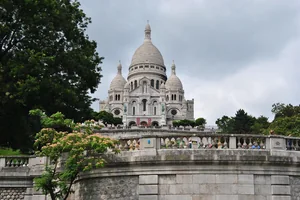
You can see it from across the city, long before you reach it. A gleaming white mirage hovering above the rooftops, Sacré-Cœur Basilica crowns the hill of Montmartre like a guardian angel. It catches the morning light and turns pink at sunset, and when you’re standing at its feet, the whole of Paris seems to spread out beneath you like a living map. It’s one of those rare sights that never loses its magic, no matter how many times you encounter it.
This isn’t your typical French cathedral. Sacré-Cœur, or the Basilica of the Sacred Heart, is a Roman Catholic place of worship dedicated to the Sacred Heart of Jesus. But it’s also a monument to a nation’s soul, a masterpiece of Romanesque and Byzantine architecture, and the highest point in Paris after the Eiffel Tower. Its stark white dome rises to a staggering 130 meters, making it impossible to miss from almost any angle. There’s an air of peaceful devotion here, yet the energy is anything but dull. Pilgrims, tourists, street musicians and sunset-chasers all mix together on the steps, creating a truly Parisian scene.
The story behind Sacré-Cœur is as dramatic as its silhouette. It all began in 1870, when France suffered a humiliating defeat in the Franco-Prussian War. Two Catholic businessmen, Alexandre Legentil and Hubert Rohault de Fleury, believed the country’s misfortunes were a divine punishment. They made a solemn vow: if France were freed from the crisis, they would build a church dedicated to the Sacred Heart. Their idea took hold, and after a massive public subscription, construction finally kicked off in 1875 under the architect Paul Abadie. Abadie’s bold design drew inspiration from Byzantine churches like the Hagia Sophia, and the result was a brilliant synthesis of Eastern and Western styles.
But the basilica’s origins weren’t without controversy. Many French people saw the project as a political statement, a symbol of royalist and conservative power during a turbulent republican era. Crowds argued, political futures were made and unmade, and yet the builders kept going. The foundation stone was laid, and the immense white stones began to climb. Those stones, quarried from the village of Château-Landon, are a special kind of travertine that self-cleans whenever it rains. That’s why the basilica stays dazzling white, century after century. Construction dragged on for nearly 40 years, reaching completion in 1914, just as World War I broke out. The consecration didn’t happen until 1919, when the world could finally breathe again. Beneath all this history lies an older tale: Montmartre, the “Mountain of Martyrs,” was where Saint Denis and his companions were said to have been killed in the 3rd century. So the hill itself had been sacred long before the basilica existed.
Step inside, and you’ll be struck immediately by the vast, glowing mosaic in the apse. Christ stands with arms outstretched, surrounded by the Virgin Mary, saints and angels, all rendered in gold and deep blue. It’s the largest mosaic in France, and it dominates the entire interior. The rest of the church is relatively dim, with soft candlelight and quiet murmurs. Visitors are welcome, but this is still an active place of worship, so keep your voice low and your phone on silent. Flash photography is a definite no-no. If you’re lucky, you might hear the great organ—it’s one of the most famous in the country, with a thunderous, heavenly voice that sends chills down your spine.
For the ultimate experience, climb the dome. It’s a cramped spiral staircase of 300 steps, but every single one is worth it. You’ll emerge high above the city, into the open air, with a 360-degree panorama that stretches for miles on a clear day. The Eiffel Tower, Notre-Dame, the Seine and the distant Montparnasse Tower all appear like a tiny diorama. Give yourself a good 1.5 to 2 hours if you also want to visit the indoor sections. The basilica itself is free to enter, which always feels like a generous gift. For the dome and the treasure/crypt area, there’s a modest ticket fee—usually around 8 euros for the dome alone, or a combined pass for a few extra euros. It’s one of the best bargains in Paris, honestly.
Now, where should you snap your photos? The wide esplanade in front of the church is the obvious winner. Stand near the central statue of the Sacred Heart and angle your camera upward to capture the domes against a perfect blue sky. The famous steps leading down are also a favorite spot, especially at golden hour, when the whole basilica glows like a pearl. For a quieter perspective, wander around to the back of the building and discover the Square Bartholomé, a peaceful garden with bench seating and a less crowded view over the city rooftops. It’s a hidden gem that most tourists completely miss. Another little-known treasure is La Savoyarde, one of the heaviest bells in Europe, weighing an astonishing 19 tons. It lives in the right tower and rings out at noon with a deep, resonant boom that you can feel in your chest.
Before you leave, take a moment to appreciate the smaller details. The crypt below the church is often overlooked, but it’s home to a perpetual adoration chapel that has been in use since 1885. Even if you’re not religious, the silence and the flickering candles create an atmosphere of profound reflection. There’s also a small museum near the sacristy, tucked away and rarely crowded, displaying religious art, vestments and relics. If you can, plan your visit for early morning or late afternoon. The basilica opens at 6:30 am, which means you could be the only one sitting in that vast, golden silence as the sun rises over Paris. Dress respectfully too—shoulders covered and knees visible are good enough, but keep it modest out of respect for the worshippers. Sacré-Cœur isn’t just a tourist stop; it’s a living heart beating at the top of the city. And once you’ve climbed its steps and looked out over the world, you’ll understand exactly why it captivates so many millions of travelers, year after year.
