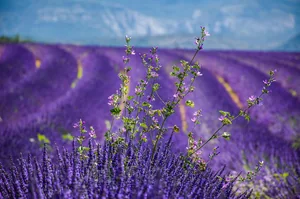
Close your eyes and picture this: endless rows of violet stretching to the horizon, the air thick with a scent that somehow feels like both honey and a fresh morning breeze. The lavender fields of Provence are more than a postcard – they’re a living, breathing masterpiece that has captured the hearts of travelers for generations. Every summer, this corner of southern France transforms into an ocean of purple, punctuated by the hum of bees and the drone of cicadas.
It’s not just about the color, though. The fields are a feast for all the senses: the touch of velvet buds between your fingers, the taste of lavender sorbet at a nearby farm, the sound of wind rustling through dried herb bundles at a roadside market. Provence has long been the world’s lavender capital, and walking those rows feels like stepping into a daydream.
But there’s a reason this place draws photographers, honeymooners, and artists from every corner of the globe. It’s the marriage of the wild mountains with the meticulous, man-made geometry of the plantations. The purple lines curve over hills and avalanche down slopes, and you’ll find yourself reaching for your camera before you’ve even made it out of the parking lot.
Lavender’s story in Provence goes back much further than the tourist rush. The Romans used lavender in their bathhouses, and some historians believe they brought the plant to the region as early as the first century AD. The very name comes from the Latin ‘lavare’, to wash. But for a long time, growers gathered wild lavender that dotted the mountainsides; it wasn’t a commercial crop.
The real shift came in the late 19th century, when a new method of steam distillation made it easier to extract the essential oils. Suddenly, lavender was a commodity, not just a fragrant curiosity. Around the same time, the French government began promoting the planting of lavender to support local farmers. By the 1920s, the plateaus of Valensole and Sault had become the heartland of the industry, with acres upon acres of purple planted in perfect parallel rows. The monks at Sénanque Abbey, who had cultivated lavender for centuries, continued their tradition, eventually creating the image that now graces a million travel posts.
World War II changed things again. Synthetic substitutes took over the perfume market, and growers had to adapt. Instead of just producing oil, they turned to tourism. By the close of the 20th century, the lavender field had become an icon of French charm. Today, Provence still produces more than half of the world’s natural lavender, and the fields remain a patchwork of history, tradition, and sheer hard work.
So what should you actually do when you arrive? First, slow down. You’re not in a museum or a theme park; these are working farms, and they’re free to walk around – inside the rows, that is. Most lavender farms are open to the public with no entrance ticket. A few, like the Sénanque Abbey, charge a small fee for guided access or the lavender trail, and some farms offer meet-and-greets with the distillery – that’s where the magic happens.
Give yourself at least two to three hours just to wander a single field. That might sound long, but the light changes every half hour, and so does your perspective. Early morning and late afternoon are your golden windows – literally. The sun casts a warm glow on the purple, and the crowds at popular spots like Valensole thin out. Midday is harsh; the colors wash out, and you’ll be squinting for a photo that does the place justice. If you can, visit two different fields: one on the plateau and one near a hilltop village like Sault. They feel oddly different – one grand, one intimate.
Photo spots aren’t hard to find. The classic shot at Sénanque Abbey, with the Romanesque stone building facing a sea of purple, is worth the morning wake-up call. You’ll also want to stand at the top of a ridge where rows of lavender fall away in symmetrical curves. Don’t just shoot your subject straight on; shoot down the rows, let the lines lead to a tree or a mountain in the distance. And here’s a hidden gem: the tiny village of Aiguines, at the edge of the Valensole plateau, gives you a view of the fields with the Lake of Sainte-Croix sparkling in the background. Almost nobody grabs that shot.
One more tip: watch for the harvest. Most fields are cut starting in mid-July, which means depending on when you come, you might witness the entire harvest and the smell of fresh-cut lavender filling the air. It’s a different kind of beautiful. And if you have time, look out for the fields of white lavender (it’s rare, but it exists as a variety) or a tiny field claiming to be ‘lavande véritable’ – true lavender – versus lavandin, the hybrid. The locals will happily explain the difference, and you’ll leave with more than just photos. You’ll leave with the scent of Provence in your blood.
