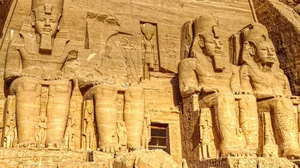
You’re standing in the middle of nowhere, surrounded by nothing but sun-scorched desert, when four colossal stone pharaohs suddenly rise from the earth. They’re not just big; they’re overwhelming, each one towering over 20 meters high, their faces frozen in an eternal stare across Lake Nasser. This is Abu Simbel, and it hits you like a heatwave. There’s no gradual approach, no gentle introduction. One moment you’re on flat, empty ground, and the next you’re face-to-face with one of ancient Egypt’s most audacious monuments.
The site isn’t just a temple; it’s a statement. Built by Ramesses II in the 13th century BC, it was designed to intimidate, to impress, and to immortalize a pharaoh who clearly thought big. But what makes Abu Simbel truly astonishing isn’t just its age or size. It’s the sheer stubbornness of its survival. This entire complex was physically cut into pieces and moved 65 meters higher up the cliff in the 1960s to save it from flooding. When you visit, you’re not just seeing an ancient temple; you’re seeing one of the greatest rescue missions in archaeological history.
The story begins around 1264 BC, when Ramesses II ordered a temple carved directly into a sandstone cliff on the west bank of the Nile. He wanted a monument to himself, his queen Nefertari, and the gods Ra-Horakhty, Amun, and Ptah. But this wasn’t just a religious site. It was a power play. Located near Egypt’s southern border with Nubia, Abu Simbel was built to remind anyone coming north that they were entering the territory of a god-king. The Great Temple’s facade alone is enough to make that point: four seated statues of Ramesses, each with the double crown of Upper and Lower Egypt, flanked by smaller figures of his family. To the side, the Small Temple is dedicated to Nefertari and the goddess Hathor, and its facade features six standing statues — four of Ramesses and two of his queen. It’s one of the few times in Egyptian art where a queen is shown at the same scale as the pharaoh.
Fast forward to 1813. Swiss orientalist Johann Ludwig Burckhardt stumbled upon the site while exploring Nubia, and the world suddenly remembered that Abu Simbel existed. But the real drama came in the 20th century. In the 1950s, Egypt’s government announced plans to build the Aswan High Dam, which would flood a vast stretch of the Nile Valley. Abu Simbel was doomed. International archaeologists scrambled, and a global campaign was launched. Between 1964 and 1968, an international team sliced the entire temple complex into more than 1,000 blocks, some weighing up to 30 tons, and reassembled them like a colossal jigsaw puzzle on higher ground. They even built an artificial mountain above the temples to preserve the original cliff face setting. It was a monumental feat of engineering, and in 1979, Abu Simbel was declared a UNESCO World Heritage Site. You should take a moment to appreciate that when you’re standing inside — you’re in a building that shouldn’t exist.
Now, let’s talk about what you’ll actually do inside. The Great Temple is all about theatrical darkness. You walk into the hall, and eight massive Osiride pillars — statues of Ramesses as the god Osiris — line both sides. The lighting is dim, the stone is cool, and the sense of being swallowed by history is almost physical. Walk deeper, and you’ll find chambers covered in battle scenes, religious rituals, and hieroglyphics. The innermost sanctuary holds a seated statue of the god Ptah and, remarkably, the famous solar alignment: twice a year, on October 22 and February 22, the first rays of sunlight reach all the way into this sanctuary to illuminate statues of Ramesses, Amun, and Ra-Horakhty, while Ptah, the god of darkness, stays forever in shadow. If you can’t visit on those exact mornings, just stand in the sanctuary at any time and try to feel the weight of that engineering precision.
Take your time here. The recommended visit is about two to three hours total, and you’ll want every minute of it. Start with the Great Temple, explore its echoing halls, then walk 100 meters north to the Small Temple. It’s smaller, yes, but far more intimate. Its facade is more graceful, with softer proportions, and inside you’ll find beautifully preserved scenes of Nefertari offering incense to goddesses. The reliefs here are some of the most elegant in all of Egypt. If you’re into details, look for the cartouches of Ramesses and the occasional Greek or Latin graffiti scratched by ancient travelers who visited the temple even in Ptolemaic times. Those tiny marks connect you to thousands of years of human curiosity.
Tickets are sold at the site itself, but here’s the thing: prices run a bit higher than at your average Egyptian monument, usually around 540 Egyptian pounds for the Great Temple and the Small Temple together. That might sound steep, but consider it an investment in visiting one of the most spectacular ancient sites on the planet. Try to arrive early, ideally when the gates open at 6 a.m. Not only will you avoid the crowds, but the morning light turns the sandstone into a deep amber glow that makes the colossi look almost alive. By 9 a.m., the tour groups roll in, and the magic gets diluted. There’s no shade anywhere, so bring water, wear a hat, and don’t forget sunscreen — the sun here doesn’t play around.
As for photo spots, the classic shot is from directly in front of the Great Temple, with the four colossi filling your frame. But don’t just snap one and leave. Walk farther back until you can frame the entire facade with the artificial hill behind it, and you’ll get a sense of the relocated setting. Another killer angle is the side view, where you can see the domed mountain that hides the temple. For the Small Temple, try shooting it at an angle with the nearby cliffs to add depth. And here’s a hidden gem most people miss: walk around the south side of the Great Temple, toward the lakeshore. There’s a lonely stone marker and a few scattered blocks that didn’t make it onto the relocation plan. They sit there silently, a quiet reminder of the enormous effort it took to move a mountain. If you’re lucky, you might have this spot entirely to yourself while the crowds are packed in front of the colossi.
At the end of your visit, find a spot in the shade near the entrance terrace. Look out over Lake Nasser and the endless desert. There are no gift shops, no rides, no restaurants perched on the cliffs here — just the temples, the water, and the silence. That’s the real magic of Abu Simbel. It doesn’t try to entertain you. It expects you to be awed. And you will be, long after you’ve turned away from the stone pharaohs and headed back to the modern world, the image of four giant faces still burning in your memory.
