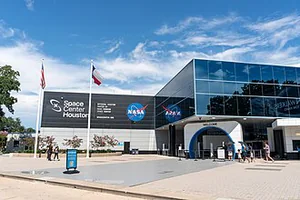
You smell it before you see it: the strange, metallic whisper of history and rocket fuel that hangs in the humid Texas air. Walk through the entrance of Space Center Houston, and you’re not just entering a museum. You’re stepping into the beating heart of America’s space program, the very place where humans learned to leave Earth and, more importantly, learned to come home.
This sprawling campus is the official visitor center for NASA’s Johnson Space Center in Houston, Texas. It’s part theme park, part working laboratory, and part cathedral to human ambition. The first thing you’ll notice is Independence Plaza, where a full-size space shuttle replica sits piggyback on a massive NASA 747 carrier aircraft. It’s impossible not to stand there, neck craned, mouth slightly open, thinking: we actually did that. Inside, you can walk the same crew compartment, touch the worn seats, and imagine the rattle of launch.
But Space Center Houston is more than a photo op. It’s a living link to the past and a window into our future. From the original Mission Control that guided Apollo 11 to the moon, to training mock-ups used by today’s astronauts, this is where dreams get engineered into reality. You don’t need to be a space geek to feel the goosebumps; you just need to be curious.
The story begins in 1961, when President Kennedy challenged the nation to put a man on the moon by decade’s end. NASA quickly chose a tract of swampy coastal prairie near Clear Lake, Texas, as the site for its new Manned Spacecraft Center. The land was donated by Rice University, and the location was no accident; it offered deepwater access, a mild climate, and easy barge transport for huge rocket parts. Ground broke in 1962, and by 1963 the first engineers were already at their desks.
The center became the beating brain of the Apollo program. It was here that astronauts trained in weightless simulators, practiced lunar landings, and studied every bolt of the spacecraft that would carry them. And it was here, in Mission Control, that a roomful of young men and women in white shirts and skinny ties guided humanity to that first moonwalk in July 1969. The iconic words “Houston, Tranquility Base here. The Eagle has landed” still ring through the building’s hallways.
Over the decades, Johnson Space Center commanded Skylab, the Space Shuttle program, and countless scientific missions. In 1992, Space Center Houston opened its doors as a nonprofit educational facility, designed with help from Walt Disney Imagineering to give the public a safe, inspiring window into this working NASA campus. Since then, it has grown into one of Texas’s most beloved attractions, with over a million visitors a year. It’s not just a museum; it’s a monument to what happens when we refuse to look down.
Your first move once inside should be to secure a spot on the official tram tour. This is the only way to enter the actual Johnson Space Center complex, and it’s absolutely worth the wait. The tour takes you past giant rocket test sites, historic hangars, and the astronaut training facility. You’ll likely spot astronauts in blue flight suits cycling through simulations, and you might even see the huge neutral buoyancy pool where they practice spacewalks. Sit on the left side of the tram for the best views.
Back inside the main building, don’t rush. The Starship Gallery holds priceless artifacts, including a lunar sample you can touch. Yes, you can actually run your fingers over a piece of the moon. The Astronaut Gallery is also unforgettable, with a wall of spacesuits and a touching memorial to those lost in the pursuit of exploration. Meanwhile, the giant Saturn V at Rocket Park will stop you in your tracks; it’s 363 feet of raw power, displayed horizontally in a monumental glass-walled hangar. Walk its entire length, from the five massive F-1 engines to the command module, and you’ll understand why it remains the most powerful rocket ever flown successfully.
Plan for at least four to six hours, though you could easily stay all day. Tickets include the tram tours, all exhibits, and most daily shows, but you’ll want to book your entry time in advance, especially on weekends and school holidays. For the truly obsessed, the Level 9 tour offers a deep dive into astronauts’ private training facilities and the historic Mission Control room, though it sells out quickly and has a higher price tag. If you want the best photos, head outside first thing in the morning; the golden Texas light makes the shuttle and 747 look even more cinematic. Also, look for the lesser-known memorial garden near the entrance; it’s quiet, reflective, and rarely crowded.
A few hidden gems deserve special mention. Don’t miss the small, easy-to-overlook film in the Boeing Experience Theater, which uses real NASA footage to simulate a launch; the seats actually shake. And if you have kids, the Mission Mars exhibit lets them plan a pretend mission, complete with a full-scale Martian terrain. But the quietest secret might be the view from the tram’s back car; as you round the corner toward the training facility, you get a haunting, wide-angle glimpse of NASA’s massive Vehicle Assembly Building on the horizon. It looks like a mountain, glowing gray and white, and it reminds you that this entire place is still busy preparing for the next big leap.
Space Center Houston isn’t just about looking back at what we’ve done. It’s about feeling, deep in your bones, what humans can do when they dare. You’ll leave with dusty shoes, a sore neck, and maybe a little stardust in your soul. You might even find yourself checking the night sky on the drive home, wondering which of those pinpricks of light is next. That’s the magic of this place; it doesn’t show you the stars, it makes you believe you can reach them.
