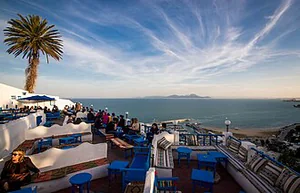
Perched on a cliff overlooking the Gulf of Tunis, Sidi Bou Said doesn’t just catch your eye—it grabs hold of your imagination. Every wall is whitewashed to a brilliant glow, every door painted a saturated shade of blue that seems pulled from the sky and sea themselves. Bougainvillea spills over terraces in explosions of magenta and fuchsia, and the scent of jasmine hangs lazy in the air. This is a place that feels like a painting, and for centuries, it’s been exactly that for artists, writers, and travelers.
But it’s more than just a pretty face. Sidi Bou Said is a living village with a soulful, layered history. It’s a place where Andalusian and Arab influences blend seamlessly, where the narrow cobblestone streets lead you to hidden courtyards, artisan workshops, and cafés that hang off the hillside. You’ll hear the call to prayer mix with the clinking of tea glasses, and sea breezes tangle with the chatter of locals. That’s the magic—it’s both a famous landmark and a genuine community.
The story starts with a holy man. In the 13th century, a Sufi mystic named Abu Said al-Baji settled on this hilltop, seeking solitude and spiritual peace. After his death in 1231, his tomb became a pilgrimage site, and the area around it grew into a village. For centuries it was a quiet, humble settlement—fishermen, farmers, and devout followers who came to pay respects. Locals painted their doors blue to bless their homes and ward off evil spirits—a tradition that became the village’s visual trademark.
Then came the Andalusians. In the 16th century, Muslim refugees fleeing Spain brought a sophisticated architectural style, with curved arches, ornate ironwork, and sculpted ceilings. The village adopted this grace, blending it with the stark white walls of North Africa. By the 19th century, Sidi Bou Said’s unique beauty attracted European artists and musicians. Paul Klee, August Macke, and Louis Moilliet visited, famously sketching the houses and streets. Their work introduced the village to the world, and the rest is history.
The early 20th century brought a significant transformation. Baron Rodolphe d’Erlanger, a French painter and musicologist, fell in love with the village and built a sumptuous palace, Ennejma Ezzahra, on the seaward cliff. He brought in craftsmen from across Tunisia and Turkey, creating a masterpiece of Andalusian and Arab architecture. He also worked to protect the village’s unique look, laying the groundwork for the strict building codes that keep Sidi Bou Said so beautifully uniform. In 1915, the village’s distinctive blue-and-white palette was officially protected. Today, the palace stands as a museum and cultural venue, a fitting tribute to the man who preserved this dream.
Start your visit by simply wandering. The main street, Rue Habib Thameur, is a ribbon of white walls and blue doors that winds downhill, but the real magic lies in the side alleys. Take any turn you like—you’ll find intimate courtyards, cats sunning themselves on stone steps, and the occasional artisan hammering copper or etching intricate tiles. Don’t be afraid to get lost; that’s honestly the best way to experience the village. Make sure you stop at the iconic Café des Délices, perched on the cliff right over the sea. Grab a glass of mint tea or a strong espresso, sit in a blue chair, and drink in the panoramic view of the Gulf of Tunis.
For a dose of culture, head to Ennejma Ezzahra. The palace is open to the public as the Centre of Arab and Mediterranean Music, and you can wander through its grand courtyards, intricately carved stucco, and tranquil gardens. The museum offers a glimpse into the lavish lifestyle of its founder, as well as displays of musical instruments and art. The entrance fee is modest, and it’s well worth it. If you’re feeling energetic, climb to the lighthouse (Phare de Sidi Bou Saïd) at the highest point of the village. The view from the old fortification wall is spectacular, especially at sunset when the sky turns the same blue as the doors.
Time-wise, allow at least half a day to soak in the atmosphere, but a full day is better if you want to linger at a café, visit the museum, and shoot some photos. The village is compact, but you’ll want to stop every few steps. There are no entry tickets for the town itself—just for the palace and maybe the museum exhibit. For photos, the most famous shot is the staircase behind the Café des Délices, where the blue doors and steps cascade down toward the sea. Also find the flower-covered alley near Dar el Annabi, and the view from the lighthouse—absolutely don’t skip that.
Hidden gems? Look for the small cemetery next to the mosque, which offers a quiet, hauntingly beautiful view of the coast. Peek into the local art galleries tucked in unlikely corners, especially the little ones without big signs. And if you really want to experience the village like a local, come early morning, before the day-trippers arrive. The streets will be almost empty, the light golden, and you’ll hear nothing but the birds and the gentle lapping of the sea far below. That’s the Sidi Bou Said that its famously blue doors want to show you.
