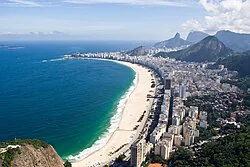
You don’t just visit Copacabana. You step into a postcard that’s been alive since the 1930s, and somehow, it still exceeds every image. Start with the arc: four kilometers of golden sand curving from the rocky headland at one end to the hills of Ipanema at the other. Then add the set: the deep blue Atlantic rolling in steady, rhythmic waves, the abrupt green peaks of Rio’s mountains rising right behind the apartment blocks, and that famous mosaic promenade—the black-and-white wave pattern that looks like an ocean rendered in geometry. This is Copacabana, and it’s not just a beach. It’s Brazil’s stage, its living room, its open-air carnival ground.
For most of the world, Copacabana means sun, samba, and skin. But walk a few steps past the futevôlei nets and the beach umbrellas, and you’ll find a place with its own heartbeat. Hawkers wander with trays of grilled cheese, coconut water, and empanadas. Families stake out their patches of sand. Cardboard-thin vendadores unfurl coolers full of beer. And over everything hangs that particular Brazilian hum—the chatter, the bartering, the thump of funk from a portable speaker, the splash of a goal being celebrated somewhere down the strand. It’s chaotic, joyful, and gloriously unpretentious. If Rio has a soul, this is where it suns itself.
You can also feel the history beneath your bare feet. The name itself is a curiosity—Copacabana comes from a Bolivian village, where a shrine to the Virgin of Copacabana was built back in the 1500s. A fisherman with a devotion to that Virgin supposedly placed a small replica at what became a fishing village here, and the name stuck. For centuries, the beach remained a quiet, hard-to-reach spot, accessible only by boat or a long hike over the hills. It took a tunnel to change everything. In 1892, the Túnel Velho—Rio’s first—connected the neighborhood to the city center, and within a few years, the fishing village began its slow transformation into an elegant seaside suburb.
The real boom came in the 1920s and 1930s. Rio’s aristocrats discovered Copacabana’s charms, and grand buildings began rising along the shore. The most famous of all, the Copacabana Palace Hotel, opened in 1923 with a dazzling white facade that still anchors the beach’s southern end. Meanwhile, the sea itself got a makeover. In the early 20th century, the city widened the beach by demolishing the old waterfront houses and dumping sand from Guanabara Bay. By 1970, the promenade we know today—designed by the legendary landscape architect Roberto Burle Marx—was completed. Its abstract waves of black and white Portuguese stone supposedly reference both the Atlantic and the small traditional fishing stripes you’d find in Portugal. But to the people of Rio, it’s simply the wave: a symbol of their city, laid out in cool stone under the blazing sun.
Now, for the visitor, the question isn’t what to do—it’s what not to do. You’re likely to want at least a couple of hours just walking the promenade. Start near the Copacabana Palace, where the beach is busiest and the people-watching earns its reputation. Stop for a coconut from a kiosk, take a dip in the water (head to a lifeguard-attended area between Postos 2 and 4), and watch the impromptu games that pop up constantly—footvolley, beach tennis, and a strange, hypnotic dance that looks like handball fused with funk. For something truly local, wander toward the far end near Posto 6, where the crowd thins out and you’ll find fewer tourists and more lifelong residents. That’s where the sand is softer, the surf is a touch more forgiving, and the sunset views of the Forte de Copacabana are outrageous.
The fort itself is a must-see, even if it costs a modest entrance fee. Built between 1908 and 1914, the military fortress was once the key to Rio’s coastal defenses. Today, it’s a beautifully preserved piece of history with underground tunnels, old cannons, and a small museum. Climb to the fort’s promenade, and you’ll get one of the best photo angles on the entire beach—a sweeping panorama of the whole curve with the Dois Irmãos mountains in the distance. Hidden gem time: right inside the fort complex, there’s a quiet café—Café Forte de Copacabana—where you can sit with an espresso at the water’s edge, surrounded by cannon walls and old azulejo tiles. It feels a world away from the bustle below, and if you hit it in the late afternoon, you’ll have a front-row seat for the lighting of the waves.
Back on the sand, don’t miss the sand artists. These aren’t your typical sandcastles—they’re oversized three-dimensional labyrinths and geometric patterns carved directly into the wet sand at low tide. Look for them near the water line, especially in the stretch between Posto 3 and Posto 5. They’re ephemeral, lasting only until the next high tide, which makes watching them built something of a performance. Another lesser-known pleasure: the sidewalk kiosks just off the beach sell much more than caipirinhas. Try the mate with lemon, a frothy, sweet cold tea that’s the beachside drink of Rio. Or a biscoito globo, the classic bag-shaped bready snack that’s been sold here for generations. It’s simple, salty, and utterly addictive.
How much time do you need? Honestly, if you just want to see it, snap a photo, and say you’ve been, you can do it in an hour. But that would be like eating one olive from a feast. Give it at least half a day—arrive in the morning, soak up the atmosphere, have a beachside lunch, and stay through the golden hour when the light turns everything honey-hued. There’s no ticket for the beach itself; it’s a public space, open 24 hours a day, and the wave promenade is completely free. The only costs are whatever you eat or drink, and the fort’s modest ticket price. As for photo spots, you’ll want the classic shot where the mosaic wave meets the sea—around Posto 2—or, for a softer scene, head to the far northern end where the beach curves toward the Leme headland. There, the promenade widens, the silhouette of the Sugarloaf appears on your right, and you’ll finally understand why someone once tried to put this exact view on every travel poster. But really, any square meter of Copacabana has that postcard quality. The trick is to let the moment in—the smell of salt and coconut, the sound of the surf over a thousand conversations, the feeling of Rio itself rolling gently beneath your towel. That’s the real attraction. And it never closes.
