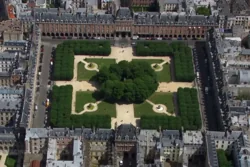
Tucked away in the heart of the Marais district, Place des Vosges feels less like a Parisian square and more like a beautiful secret. It’s a perfect rectangle wrapped in red brick and cream stone, with steep slate rooftops rising above a serene, tree-lined garden. Step under any of its covered arcades and the city’s traffic suddenly fades. All you hear is the crunch of gravel, the laughter of children, and the gentle splash of the fountain at the center. Make no mistake, this isn’t just any old plaza. It’s the oldest planned square in Paris, and it has been turning heads for over four hundred years.
The square’s symmetrical architecture is a love letter to order and harmony. Thirty-six elegant townhouses, known as hôtels particuliers, look down on the manicured lawns. They stand shoulder to shoulder, each with the same steeply angled roofline, yet each subtly unique in its doorways and ironwork. The ground floors are occupied by art galleries and cafés tucked under vaulted stone arcades. It’s a place made for lingering. And it’s easy to see why Victor Hugo chose to live here for sixteen years; the square seems to hold time itself within its walls.
The story of Place des Vosges begins with a royal tragedy. In 1559, King Henry II was killed in a jousting accident near the site. The ordeal left his widow, Catherine de’ Medici, so distraught that she abandoned the royal residence, the Hôtel des Tournelles, and ordered it demolished. For decades, the land sat empty, eventually used as a horse market. Then came King Henry IV, a visionary who wanted to make Paris more elegant. In 1605, he took this vacant plot and turned it into a grand aristocratic playground. He commissioned the construction of a symmetrical square, with royal pavilions at either end: the Pavillon du Roi and the Pavillon de la Reine. The work finished in 1612, and was inaugurated with a lavish three-day celebration to mark the marriage of Louis XIII and Anne of Austria.
At first, the square was called Place Royale, and it quickly became the most fashionable address in Paris. Nobles flocked to live there, hosting glittering parties and dangerous duels. The most famous duel? That would be the one in 1627 between the Comte de Bussy-Rabutin and the Marquis de Sourdis, fought right on the grass and followed by curious crowds from the windows above. During the French Revolution, the square lost its royal title and, for a time, its occupants. In 1800, Napoleon Bonaparte came up with a rather transactional name: Place des Vosges, in honor of the first French department to pay its war taxes on time. The name stuck, and the square survived all the upheavals of the centuries, slowly morphing from a royal arena to the bohemian, cultured corner of the Marais we see today.
Now, for the visitor, the square is a pure delight. Start your exploration by walking into the center. The green space is divided into four quadrants by gravel paths, and it’s the perfect spot for a relaxing pause. If you’re traveling with kids, they’ll find sandpits under the chestnut trees. If you’re alone, find a shady bench and watch the Parisians go about their day. There are two symmetrical fountains, fed by an ancient aqueduct, and they make a lovely backdrop for a quiet afternoon. Don’t just stand on the grass though; take a full loop and enjoy the gardens from every angle. The landscaped flowerbeds are replanted seasonally, so it looks different in spring, summer, and autumn.
Your next stop should be the Maison de Victor Hugo, located in the southeast corner of the square at number 6. This is one of the best things to do here. The great writer lived on the second floor for sixteen years, and the apartment has been carefully restored to look as it did in the mid-1800s. You’ll see his personal furniture, portraits, and even some of his handwritten drafts. The museum is compact, so you can easily get through it in under an hour. There’s no ticket required for the square itself, and that’s a rare luxury in Paris. The Victor Hugo museum costs a modest fee, but it’s free on the first Sunday of each month. Always check the official opening hours before you go, as they can change.
So how much time should you plan for Place des Vosges? I’d say at least an hour and a half, but you could easily stretch that to a full afternoon. It’s a place where you should intentionally do very little. Stroll the arcades, pop into a rare-book shop, admire the art galleries that line the north side, and then settle in for a coffee at one of the cafés under the arches. You don’t need a ticket to enter the square, and there’s no closing gate. But the garden itself does lock at night, so keep an eye on the posted hours if you plan to linger after sunset.
Now, let’s talk about photo spots. The best shot is from the middle of the lawn, facing the Pavillon du Roi, which gives you that perfect symmetrical view. Early morning light is gentle and golden. If you come around dusk, the honey-colored stone begins to glow beautifully. Another secret angle? Stand at the far corner and shoot down one of the arcades. The repeating arches create a gorgeous natural frame for your subject. And don’t miss the quiet double-arched entrance on the Rue de Birague; it’s the grand doorway that originally greeted royalty, and it’s a magical portal to step through.
Hidden gems are everywhere if you know where to look. For instance, the square’s perfectly uniform houses actually have secret gardens tucked behind them. While you can’t enter most of these private courtyards, sometimes a gate is left ajar. Peek inside and you’ll see ivy-covered walls and hidden courtyards that feel untouched by time. Another little-known feature is the small stone pavilion at the south-west corner, where a plaque marks the old footprint of the Hôtel de Tournelles. Most tourists breeze right past it. And if you’re a geek for Parisian history, take a moment to examine the statues at the square’s corners; they represent the four seasons, and they’re original pieces from the 17th century that have weathered the city’s storms elegantly.
At the end of the day, Place des Vosges is more than a postcard. It’s a living, breathing slice of Paris where elegance and everyday life walk hand in hand. You might come for the history, but you’ll stay for the calm. And as the light fades and the windows light up above the arches, you’ll understand why this hauntingly beautiful square has captured hearts for generations. Whether you’re a first-time visitor or a seasoned traveler, don’t miss the chance to sit in its garden and simply watch the world turn. It’s a memory you’ll carry with you long after you’ve left the Marais.
