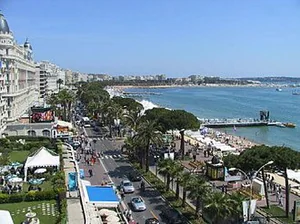
The first glint of turquoise hits you before you even reach the pavement. Suddenly, the crowd parts, and there it is—the Boulevard de la Croisette, curling along the Baie de Cannes like a ribbon of pure glamour. Palms lean over the promenade as if they’re eavesdropping on millionaire conversations, while the sea tosses sapphire sparks onto the shore. This isn’t just a street; it’s a stage, and everyone walking it is a supporting actor in the never-ending show of the French Riviera.
Its name comes from the little cross (“petite croix”) that once marked a hill at the eastern end. But today, the only symbol that matters is the red carpet of the Palais des Festivals, the fortress-like building guarding the western terminus. During the film festival, the Croisette becomes a living graveyard of decency—stars in impossibly high heels dodge paparazzi, studio executives negotiate over espressos, and the whole world watches. Yet even on a gray Tuesday in January, the boulevard buzzes with a lazy, confident energy that feels quintessentially French.
The Croisette wasn’t always a Hollywood fantasy land. In the early 1800s, the shore was just a rough, rocky coastline with tiny fishing hamlets. Then came Lord Brougham, an English ex-chancellor (or maybe a disgraced politician, depending on your perspective) who, in 1834, got stuck in Cannes on his way to Italy due to a cholera breakout. He fell so hard for the place that he built a villa and started inviting British aristocrats. Suddenly, the locals realized they had a goldmine—the winter sun.
The boulevard itself was born in 1863, when the town council approved a 3-kilometer (roughly 2-mile) riverside path along the shore. Over the decades, walls of mansions replaced fisherman’s huts. The grand hotels—the Carlton, the Majestic, the Martinez—sprouted like elegant mushrooms, each competing for the best sea view. The famous red carpet debuted in 1946 with the first wave of the Cannes Film Festival, and by the 1950s the Croisette became a magnet for the world’s most beautiful people. The boulevard was extended and widened several times, most notably in the 1930s and again in the 1980s, but its soul remains: a place where the Med meets money, and both are on display.
What should you actually do with your time here? Start at the Palais des Festivals, even if you’re not a film buff. The iconic steps, which look far less dramatic in daylight than they do under orange TV lights, are free to wander. From there, walk east along the promenade. Don’t rush—the boulevard is only 3 kilometers long, but it rewards a slow, aimless stroll. You’ll pass the port with its impossible boats, then the public beaches, and finally the quiet gardens that stretch toward the tip of the peninsula. Allow at least two hours if you want to soak up the atmosphere, but most visitors find that a half-day disappears in no time.
The best part? The boulevard itself is completely free. No ticket, no gate, no waiting in line. The public stretches of sand between the grand hotels are also open to everyone, though the most fashionable loungers require a reservation at a private beach club. If you want the full experience without paying, grab a gelato (the pistachio at the old-school kiosks is a must) and find a bench between bouts of wandering.
For photography, strike gold at the red-carpet steps—arrive early before tour buses and street performers crowd the view. The winding curve just in front of the Carlton hotel, with its blue-and-white striped awnings, is a classic postcard shot. Then, walk past the Hôtel Martinez to the tip of the Pointe Croisette, where the Esterel mountains rise in the distance across the bay. That little stretch is a secret that most visitors miss; it’s quiet, breezy, and feels a world away from the festival crush.
Hidden gems? Turn your back to the sea for a moment and look for the narrow staircases that disappear into the old town, Le Suquet. On the eastern end of the boulevard, you’ll also find the Contes de Perrault garden, a small shaded park with a whimsical statue of Little Red Riding Hood. It’s a surreal contrast to the polished chrome yachts floating nearby. And if you’re lucky enough to be there during the off-season, you might see the boulevard’s other face—old men playing pétanque under the palms, the sea breeze rattling the fronds, and not a single limousine in sight.
Ultimately, the Croisette is a contradiction: a place that’s both exorbitantly glamorous and deeply ordinary. It’s a street where the super-rich toast the sunset, and where a barefoot toddler chases pigeons at the water’s edge. That’s its magic. And it’s waiting for you.
