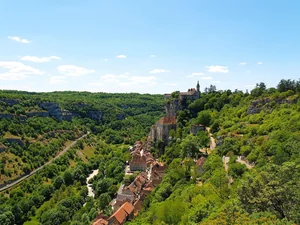
Picture this: an emerald river loops lazily between sheer limestone cliffs, and on almost every high point, a storybook castle rises from the mist. That’s the Dordogne Valley in a nutshell. Known to the French as the ‘Vallée de la Dordogne’, this corner of southwestern France isn’t just another pretty rural region. It’s a living museum where you can paddle beneath medieval fortresses in the morning, stand face-to-face with 17,000-year-old cave paintings in the afternoon, and then feast on truffles and foie gras as the sun sinks behind oak forests. For many travelers, it’s the France they dreamed of before they ever boarded a plane.
It’s a place that makes you slow down. The valley has a way of pulling you into its rhythm, whether you’re drifting along the river in a canoe, wandering through villages where laundry flutters from honey-colored stone houses, or simply sitting in a cafe and watching the light play across the water. Its fame rests on a perfect blend: extraordinary prehistoric heritage, medieval military history, and a gastronomic culture that borders on religious devotion. Yet despite its celebrity, the Dordogne Valley still feels intimate, personal, and full of secrets waiting to be uncovered.
The story of this valley begins long before castles or even towns. Around 17,000 years ago, during the Upper Paleolithic, prehistoric people painted extraordinary animals on the walls of caves near the village of Montignac. The most famous of these is the Lascaux Cave, discovered in 1940 by a teenage boy and his dog. The paintings of bulls, horses, and stags are so sophisticated that experts initially refused to believe they were genuine. Lascaux wasn’t an isolated phenomenon, though. The whole region is honeycombed with decorated caves, from the rouffignac’s engraved mammoths to the Font-de-Gaume cave’s polychrome bison. These weren’t just doodles; they were ceremonial, spiritual, and deeply meaningful. The valley was one of the most important cultural centers of the ancient world, long before the pyramids were built.
Fast forward to the Middle Ages, and the Dordogne Valley became a frontier, a battleground, and a prize. In the 12th century, the region belonged to Eleanor of Aquitaine. When she married Henry II of England, the valley suddenly became part of a vast Angevin empire. Then came the Hundred Years’ War between England and France, a 116-year conflict that turned every hilltop into a fortress. The result is a landscape scattered with bastides (fortified towns) and châteaux that seem to grow straight out of the rock. Château de Beynac, perched on a 150-meter cliff, was a key French stronghold, while the rival Château de Castelnaud across the river supported the English. They stare at each other belligerently to this day, a frozen tableau of a war that defined the region. Later, during the French Wars of Religion in the 16th century, the valley witnessed even more bloodshed, but also the construction of exquisite Renaissance châteaux and pleasure gardens. That turbulent past is precisely what gives the Dordogne Valley so much texture today.
As a visitor, your biggest challenge will be deciding what to see first. Start with Lascaux IV, the newest and most complete replica of the original cave. It’s an immersive experience, not just a copy. The designers went to extraordinary lengths to recreate the exact atmosphere: the temperature, the humidity, even the faint scent of the air. You’ll walk through dim, echoing chambers and gaze at the same creatures that amazed our ancestors. The original cave is closed to the public to preserve the fragile art, but Lascaux IV is so faithful that most people forget they’re looking at a replica. It’s an absolute must-see, and you should book your tickets online before you arrive because they do sell out during summer. Budget at least two hours for the guided tour and exhibition. If you’re eager for the real thing, though, seek out Font-de-Gaume, one of the last decorated caves in the world that’s still open to the public. Entry is strictly limited to around 30 visitors per day, so you’ll need to line up early or book ahead. The ochre bison and reindeer there are original Ice Age masterpieces, and the intimacy is breathtaking.
Beyond the caves, the valley’s showcase is its string of imposing châteaux. Château de Beynac is the dramatic one you’ve likely seen in photos: the one that towers over the river and seems almost impossible to assault. Climb its steep rampart steps and you’ll be rewarded with a panorama that stretches for miles. Cross the river to Castelnaud-la-Chapelle, which now houses a slightly quirky but fascinating museum of medieval warfare. Crossbows, trebuchets, and suits of armor fill the halls, and the rooftop view gives you a sense of exactly why these two castles were built opposite each other. For a change of pace, head to the gardens of Marqueyssac, a hanging garden set on a cliff high above the river. Strolling along its 6 kilometers of manicured boxwood hedges, you’ll find perfectly placed viewpoints and stone benches. It’s the best spot in the valley to watch the sunset paint the limestone cliffs gold. If you’re feeling active, consider renting a canoe for a half-day paddle between La Roque-Gageac and Beynac. You’ll float past weather-worn villages, canoe beneath steep cliffs, and understand just how the river shaped this entire region. That’s the quintessential Dordogne experience.
How long do you need? If you’re focusing on the core highlights—Lascaux IV, the two famous castles, and a lazy river trip—plan for two and a half to three days. But honestly, you could spend a week here without running out of things to see. Each site has its own small admission fee; expect to pay around €14-16 for Lascaux IV, €10-12 for each castle, and a bit more if you combine tickets. Most places are open from spring through late autumn, though hours shrink outside the June-September peak season. For photos, the sharpest shot of Beynac Castle comes from the riverbank east of the village, just as the morning light hits the stone. For La Roque-Gageac, the classic postcard angle is from the road above the village, or better still, from a canoe on the water. And don’t overlook the hidden gems: the exquisite 12th-century abbey of Saint-Amand-de-Coly is a quiet, romanesque masterpiece that feels a thousand miles from the tourist crowds. The tiny hilltop village of Saint-Jean-de-Côle, with its medieval bridge and weekly Sunday market, serves as a perfect, unhurried afternoon stop.
Ultimately, the Dordogne Valley isn’t a place you tire of. It’s a place you keep returning to, in your memories and maybe in person. Whether you’re fascinated by the dawn of art, obsessed with medieval battles, or simply craving a landscape of staggering natural beauty, this valley delivers. Just be careful: it has a way of stealing your heart. Don’t say no one warned you.
