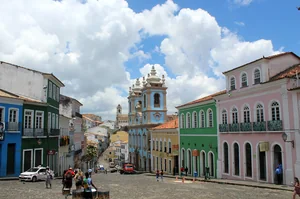
The moment your feet hit the cobblestones of Largo do Pelourinho, the air changes. Salsa rhythms tumble from open windows, fried-acaraje wafts from street stalls, and the old colonial town doesn’t feel like a museum at all. It feels alive. Rising from Salvador’s Cidade Alta, this UNESCO World Heritage district is a chaotic mosaic of pastel-yellow mansions, deep-blue church towers, and tangled street wires that snake over balconies. And yet, beneath the colors lies a brutal story; ‘pelourinho’ means ‘pillory,’ the stone block once used to publicly punish enslaved Africans. So this isn’t just Brazil’s most Instagrammable neighborhood—it’s also its most historically tangled.
Living, dancing, and praying in the same streets where people were once bought and sold gives Pelourinho a profound, almost electric tension. You’ll see capoeira sparks in the main square, old men playing dominoes under a tamarind tree, and a sea of tourists doing exactly what you’re doing: trying to take it all in. The neighborhood sits on a bluff overlooking the Baía de Todos os Santos, and the ocean breeze sweeps through the near-vertical alleys, carrying the smell of roasting nuts and salty spray. It’s overwhelming—but that’s the point.
Salvador began in 1549 as Brazil’s first capital, founded by the Portuguese aristocrat Tomé de Sousa. He chose this high plateau for defense, with the city’s administrative heart right on the edge of the cliff. For nearly three centuries, Pelourinho was the center of Portuguese power in the New World, but its success was built on sugar and enslaved hands. By 1558, the first captive Africans were forced through Salvador’s port, and within decades, the traffic had turned this region into the Atlantic world’s largest slave trade depot. The pillory itself was no ornament; it was the law’s brutal end, where escaped captives had their ears cut or received lashes while the whole town watched.
As the sugar trade swelled, the colony’s elite poured riches into the district. Franciscan monks erected the Convent of São Francisco, whose massive Church of St. Francis was completed in 1723, its interior gilded with 500 kilograms of gold. Wealthy merchants built sobrados—tall, tiled townhouses whose azulejo panels and decorated facades remain iconic today. But by the end of the 19th century, Salvador had lost its political status and the neighborhood fell into decay. After slavery was abolished in 1888, discrimination and urban poverty swept through Pelourinho. Decades of neglect destroyed many of the old structures. Then, in 1985, UNESCO named the Historic Center a World Heritage Site, and a major restoration of the old quarters began. Critics call it sanitization, but without it, many of these priceless buildings might have collapsed. Either way, the neighborhood today is a testament to both suffering and survival—an African-rooted culture that refused to fade.
Start your visit in Largo do Pelourinho, the sloping, tilted square that gives the district its name. From here, the streets fan out like an open hand. Give yourself at least half a day; the district is compact but layered. The free highlights alone—the church plazas, the blue-washed houses, the open-air sculptures—can fill two or three hours. For a deeper dive, step inside the Fundação Casa de Jorge Amado, a 1700s masterpiece dedicated to the celebrated Bahian writer, and then duck into the nearby Museu Correios, housed in a mesmerizing 1902 post-office palace. Both are small, manageable, and rarely crowded.
Ticket-wise, you won’t find a single gate to Pelourinho. The streets are public, and you can wander for free. But churches and museums often charge small fees, and they’re worth it. At the Igreja do Rosário dos Pretos, built by enslaved people and freed Africans starting from the 1700s, the modest entrance fee feels more like a donation—it funds maintenance of one of the most moving parts of the neighborhood. For the grande dame, the São Francisco Church and Convent, you’ll pay roughly R$10 and witness a jaw-dropping interior where baroque gold leaf covers every column. Bring cash, as some smaller institutions don’t accept cards.
For photographs, head to the Praça Teresa Batista in the late afternoon. The low sun rakes across the pastel walls, and you’ll get that famous view of the Catedral Basilica’s towers against the sky. Another perfect spot is the azulejo-covered staircase on Rua do Passo—it’s relatively empty and framed by bougainvillea. But for a hidden gem, walk up the Rua Gregório de Mattos until you see a narrow iron gate; through it, a small miradouro offers a stunning sideways glimpse of the bay and the surrounding rooftops. Most visitors never find it.
At night, Pelourinho morphs into a spontaneous festival. Drumming groups like Olodum hold rehearsals in the open squares, and locals and travelers begin dancing right under the streetlights. A word to the wise: keep your phone close and your bag zipped, because the crowds get thick and pickpockets are occasional. But don’t let that scare you off; it’s all part of a place that’s always been about overcoming struggle with art. If you’re lucky, you might catch a capoeira roda breaking out in a random corner—the berimbau’s tense, rhythmic twang pulling a circle of spectators closer. These are the moments that define Pelourinho.
