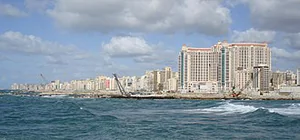
Salt air clings to the Corniche, where the Mediterranean tosses its restless blue against a city that refuses to fade quietly into memory. Alexandria—Egypt’s second city, its ancient window to the world—sprawls along the coast with a faded, glamorous grace. You’ll find crumbling colonial balconies next to sleek glass towers, fishmongers shouting beside cafes brewing thick Turkish coffee, and everywhere, the ghost of Cleopatra whispering from the stones. This isn’t Cairo’s chaotic grandeur or Luxor’s temple-lined eternity. Alexandria is something else entirely: a city of layers, where every wave seems to wash up a story.
It’s famous, of course, for the Lighthouse of Pharos—one of the Seven Wonders of the Ancient World—and for the Great Library that once held the sum of human knowledge. But Alexandria is more than a relic. It’s a living, breathing mosaic of Greek, Roman, Arab, and modern Egyptian life. Come for the legend, stay for the light. The light here is unlike anywhere else on the Nile delta: golden, hazy, and tinged with sea salt, as if the city itself is always a little dreamy, a little suspended between myth and memory.
The story of Alexandria begins with a conqueror who never saw it finished. In 331 BCE, Alexander the Great paused on a stretch of Mediterranean coast between the sea and Lake Mareotis, declared it perfect, and ordered a city to rise. He left soon after, but his general Ptolemy turned Alexandria into the capital of a dynasty. Under the Ptolemies, the city became the intellectual heart of the ancient world. Scholars flocked to the Mouseion and the Great Library, where Eratosthenes measured the Earth’s circumference and Euclid wrote his geometry. Meanwhile, the towering Pharos lighthouse guided ships safely into the twin harbors—a marvel of engineering that stood for nearly 1,500 years before earthquakes toppled it.
Rome came next, and with it, Cleopatra and Mark Antony’s doomed love affair. After their defeat at Actium in 30 BCE, Alexandria fell under Roman rule and eventually faded as a political center, though it remained a thriving trading post. The Arabs conquered the city in 641 CE, and by the Middle Ages, Alexandria was a shadow of its former self—a sleepy fishing town hugging the ruins of greatness. Then came Muhammad Ali in the 19th century, who revived the city, and the cosmopolitan boom that followed brought Greeks, Italians, Jews, and Levantines together. That rich, tangled history is written in the city’s bones. You can feel it in the catacombs, see it in the Ottoman-era mosques, and taste it in a plate of fresh seafood at a dockside restaurant.
So how do you actually visit Alexandria? Most travelers make a beeline for the Bibliotheca Alexandrina, the modern homage to the ancient library. It’s a stunning disc of granite and glass tilting toward the sea, inscribed with letters from every known script. Inside, you’ll wander through soaring reading halls bathed in filtered sunlight, explore a museum of antiquities tucked beneath the main floor, and gawk at a rare collection of ancient astronomical instruments. The manuscript restoration lab offers a glimpse through glass at conservators coaxing life from fragile papyrus. Give yourself at least two to three hours here. Tickets are around 70 Egyptian pounds, and there’s a small extra fee for the planetarium. For a photo, step out onto the waterfront promenade in front of the library—especially at golden hour, when the granite disk glows like a fallen sun.
Just a short drive away stands Qaitbay Citadel, built in 1477 on the exact foundations of the ancient Pharos lighthouse. The Mamluk sultan Qaitbay reused the fallen lighthouse stones, and today the fortress guards the harbor with thick walls and round towers. Climb to the top for panoramic views of the sea and city—this is the single best photo spot in Alexandria, especially with fishing boats bobbing in the foreground. Inside, you’ll find a small mosque and a maze of military chambers. Most visitors spend about an hour here. Admission is a modest 60 pounds, and the light is magical in the late afternoon when the sun dips behind the Mediterranean. Hidden gem: walk around the outside walls to the eastern side, where you’ll find locals fishing off the rocks and a tiny, unmarked café that sells the best hibiscus iced tea in town.
Underneath the city lies another world—literally. The Catacombs of Kom El Shoqafa, discovered by accident in 1900, are a three-tiered underground necropolis carved into rock in the 2nd century CE. The fusion is astonishing: Egyptian funerary motifs painted alongside Roman columns, and Greek-style statues bearing an eerie, smiling stillness. You’ll descend a spiral staircase into dim, cool chambers where families once buried their dead. Allow an hour to explore the maze of tombs, including the famous “Triclinium” banquet hall, where mourners shared meals with the dead. Tickets are inexpensive—around 80 pounds—and the site rarely feels crowded. Bring a flashlight if you want to peer into the deeper niches; the overhead lights are dim and flicker in a way that’s more atmospheric than illuminating. One lesser-known feature: a tiny window in the main tomb chamber that was deliberately positioned so the sun would hit the statue of the god Anubis on the winter solstice.
Finally, carve out a little time for Pompey’s Pillar, a 25-meter granite column that stands alone on a dusty mound in the old Serapeum district. It’s not much—just one column, really—but it’s the largest of its kind outside Rome, and it’s a survivor. Erected in 297 CE to honor Emperor Diocletian, it watches over a scattering of sphinxes and underground galleries where ancient mystery cults once met. Climb the small hill and you’ll get a strange, almost melancholic view of the city. There’s a ticketed entrance (about 80 pounds), and you’ll need only twenty minutes—but those twenty minutes are a perfect way to end your Alexandria journey, standing beside a proud column that has outlasted empires. The real hidden treasure lies in the subterranean tunnels beneath the pillar, where recent excavations have uncovered a Ptolemaic temple complex. You can’t go inside, but peering through the grates is enough to spark your imagination.
That’s the thing about Alexandria: it rewards the curious. The city doesn’t hand over its secrets easily. You have to wander into side streets, listen for the echoes of old languages in the market banter, and let the sea breeze rearrange your assumptions. Missing the sunset from the Corniche would be a crime, and skipping a plate of grilled shrimp at a waterfront kiosk would be a tragedy. But for all its practical attractions, the real magic of Alexandria is emotional. You know you’re standing in a place that once taught the world how to think. And even though the great library is gone, the spirit of inquiry lingers in every cafe conversation and every crumbling stone. Come with time, leave with wonder.
