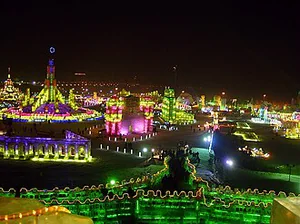
Step off the wind-blasted streets of Harbin into a place that shouldn’t exist. Neon towers stab at a pitch-black sky. Chandeliers of pure ice glitter inside cathedral-like halls. Children slide down translucent slides that glow electric blue and magenta. The temperature sits at minus twenty-five degrees Celsius, yet you’ve never felt more alive. This is Harbin Ice and Snow World, a temporary city built from over 200,000 cubic meters of ice and snow, condensed into just three months of feverish construction.
Every winter, the world’s largest ice theme park rises from the frozen banks of the Songhua River, only to melt away in spring. That’s the magic of it. Nothing is permanent here. Each year brings a fresh design, a bolder scale, a more impossible silhouette. Visitors flock from across the globe to wander through a labyrinth of ice castles, watch laser shows dance across translucent walls, and sip warm tea while staring down an ice throne room. It’s not just a sculpture park. It’s a full-on fantasy realm, built to last one season.
The story of this frozen wonderland begins far earlier, back in 1963, when Harbin held its first ice lantern show in Zhaolin Park. Inspired by the simple lanterns that farmers made by freezing water and inserting candles, local artists carved blocks from the river and carved out a winter spectacle. That first show drew tens of thousands. Then came the Cultural Revolution, and the tradition fell silent for nearly two decades. It wasn’t until 1985 that the Harbin International Ice and Snow Festival was reborn, laying the foundation for everything that exists today.
The Ice and Snow World itself opened its gates in the winter of 1999, just in time for the millennium. Local sculptors, engineers, and construction crews worked around the clock, harvesting huge blocks of ice from the river and moving them with cranes and muscle power. From those humble beginnings, it exploded into a world-famous attraction. International ice sculpture competitions began happening inside the park, drawing artists from Japan, France, Russia, and beyond. By the mid-2000s, the site expanded to a sprawling 750,000 square meters, dotted with replicas of the Great Wall, a mini Niagara Falls, and ice versions of the Forbidden City.
What makes this place historically significant isn’t just the size. It’s the audacity of it. In a region where winter lasts half the year and temperatures can plunge to minus thirty degrees, the people of Harbin turned their harshest season into their proudest art form. The park is a symbol of resilience, of making joy out of ice. And every December, a new team of nearly ten thousand workers builds the entire city in about two weeks flat. That’s a feat of logistics, sweat, and sheer willpower.
Once you’re inside, you’ll want to start with the headline attractions. The largest ice castle, often designed after Chinese palaces or classical European architecture, towers over central square. Every block of ice has been cut from the river and fitted together without mortar, then lit from within by colorful LEDs. You can climb the stairs, cross a frozen balcony, and look out over the whole glowing metropolis. There’s also the ice slide — enormous, winding tubes carved entirely from frost. Grab a rubber mat, lie back, and feel yourself rocket across a rainbow of frozen energy. Some slides stretch over three hundred meters long. Don’t skip them, even if your fingers are numb.
Plan to spend at least three to four hours here. The park opens around noon, but the real magic starts around 4 pm, when the winter sun dips low and paints the ice in pale pink and gold. Then darkness falls, and the interior lights switch on, turning every structure into a dreamscape. I’d recommend coming in the late afternoon and staying well into the evening. You’ll get both the daylight detail and the full neon spectacle. Ticket prices change every year, but typically run between 280 and 400 yuan per person. It’s not cheap, but for what you’re getting — an entire city hand-carved from frozen water — it’s genuinely one of the best-value spectacles on earth.
Finding the perfect photo here is almost too easy. The central palace plaza is the obvious spot, and for good reason — the symmetrical towers behind you create a jaw-dropping frame. Head to the top of the main ice slide for an elevated view, or walk to the far northern edge of the park, where fewer crowds gather, and you can capture the glowing spires reflecting off the icy snow like a mirror. If you’re lucky enough to catch a snowfall, stay right where you are. Snowflakes drifting through the colored light make for the most magical shots you’ll take all year.
But the hidden gems are what separate the casual visitor from someone who truly saw the park. Walk past the giant cathedrals, and you’ll find a quiet ice maze where you’ll lose your bearings as frozen walls rise above your head. There’s also an ice bar that serves drinks in glasses carved entirely from ice — sipping a vodka there feels like a scene out of a James Bond film. Look for the small art pavilions tucked behind the main plazas, where Chinese master carvers display intricate, lace-like ice sculptures that are often overlooked. And if you need to warm up, several pavilions feature cozy, heated observation lounges with huge windows — perfect for a break without missing the view.
A few practical notes from someone who’s been there. Wear everything you own. Thermal layers, a serious down coat, thick wool socks, and insulated boots are not suggestions. Hand warmers are practically essential. The wind off the river cuts straight through fabric. Also, remember that the ice sculptures are structural, not just decorative. You can touch them, walk on them, and even hug them — but be careful of slippery surfaces and sudden puddles, since the ground is constantly refreezing. One more thing: stay for the laser shows. They happen every hour after dark, and they turn the main castle into a swirling canvas of light and music. Trust me, you won’t want to leave until they kick you out.
Harbin Ice and Snow World isn’t merely an attraction. It’s a brief, brilliant rebellion against the cold, a celebration of a season most cities try to endure. Every winter, it rises from the frozen river, dazzles millions, and melts back into memory. Visit it, and you’ll carry those glowing images with you long after the ice is gone. Winter has never been so beautiful.
